2 - Search Problems and God's Algorithm
ucla | CS 161 | 2024-01-10 14:14
Table of Contents
- General Search Problems
- 8-Puzzle Formulation
- Uninformed search observations
- Search Trees
- Missionaries and Cannibals
- 8-queens
- Crypt-arithmetic
- Knut’s Problem
- State Formulations
General Search Problems
Types of Problems
- 8-puzzle (sliding numbered pieces in a grid to be ordered)
- rubiks cube
- missionaries and cannibals (moving across the river)
General Structure
- Initial state
- final state
- actions
- transition/successors
- cost for actions
Task
- find set of actions to move from initial state to goal state
- usually with lowest cost overall cost of actions
Process
- consider all possible moves at every state
- consider consequential moves
8-Puzzle Formulation
Problem
- grid 3x3 with blocks numbered 1 through 8
- initial state: randomized order
- goal state: some ordering of the blocks
- actions: slide blocks up/down left/right
Simplifying actions
- instead of consider all possible number blocks AND directions
- we can just look at which number to move bc only 1 open blank square
- BUT, instead we can just look at where to swap the blank to to adjacent blocks
Uninformed search observations
- states are atomic - no internal structure, we just observe states as some random internal state identified by a pointer/code/hash
- states are discrete - each state is unique and distinguishable by value from other states
- no percepts - we cannot observe state transitions as we perform actions (i.e. we solve the rubiks cube blindfolded just knowing the initial and final states)
- deterministic transitions - no unintended consequences or possibilities of errors e.g., UB from valid moves
- choice of action states is important
- move tile x, UDLR
- move tile
- move blank UDLR
- move blank
- actions may not be applicable to all states - transition to OOB state e.g., game over, destroyed, corrupt, etc.
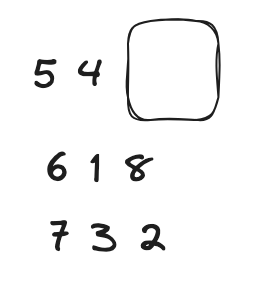
Search Trees
- representation of all states resulting from all possible actions
- each node is the state and each edge is the action e.g. D for blank down
- redundant states can be identified and ignored in drawing search trees - note identifying when this happens can be difficult in other problems
- the solution is the set of actions that lead from initial state to end state, i.e. tree search
- we might have infinite repeating states or infinite unique states - not in the solution
- NOTE: search space is the set of all possible unique states within 1 action of another state in the set
Observations
- avoid repeated states
- cost here is measured as length of the path
- difficulty of problem measured via problems
- number of unique states
- branching factor, e.g. 3x3 puzzle has at most factor of 4
- solution depth
- some problems may become unsolvable as difficulty increases so algo’s should look at average cost to solve
- e.g. 8-puzzle is NP-complete, thus a hugely large grid can be solved in the same time iff P=NP (which so far is not true)
Missionaries and Cannibals
8-queens
Machine
- you have chess board an want to place 8 queens such that no queen is attacking another
- initial state: empty board
- state space: all possible placements of 0<=n<=8 queens
- action/transition space: placing a queen
- goal state: 8 queens on board not attacking
Optimization
- this setup has 64! nodes in the decision tree
- we can constrict the action space by limiting actions to only those that are valid moves but this is still large
- now we can also avoid redundancy in permutations by working row by row to limit the branching factor
- this bring it down to 2057 possibilities
Crypt-arithmetic
Problem
- we are given a sum of words, we must asssign a digit to each character to make the sum correct
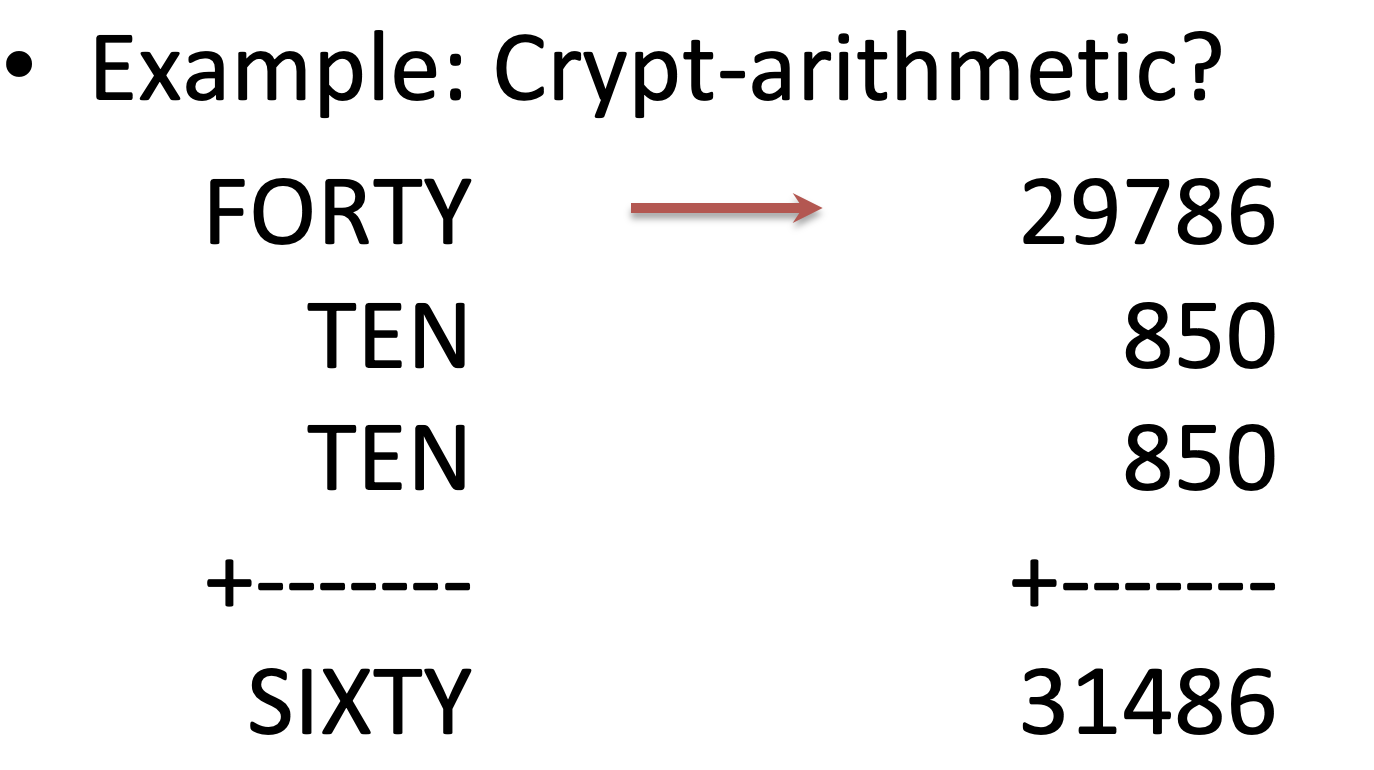
Iterative solution
- assgn each digit to a letter iteratively and branch so each level has 10 branches
Swap solution
- randomly assign, then swap while meeting constraints
Knut’s Problem
Problem
- initial: some number: 4
- final: some number: 5
- actions: factorial, sqrt, floor
Conjecture
- there exists a solution for all numbers to all numbers
- state space is infinite