9 - Propositional Logic
ucla | CS 161 | 2024-02-26 14:22
Table of Contents
- Basic Concepts
- Relationships between Sentences
- Reductions
- Monotonicity of logic
- Normal Forms
- Logical Inference
Basic Concepts
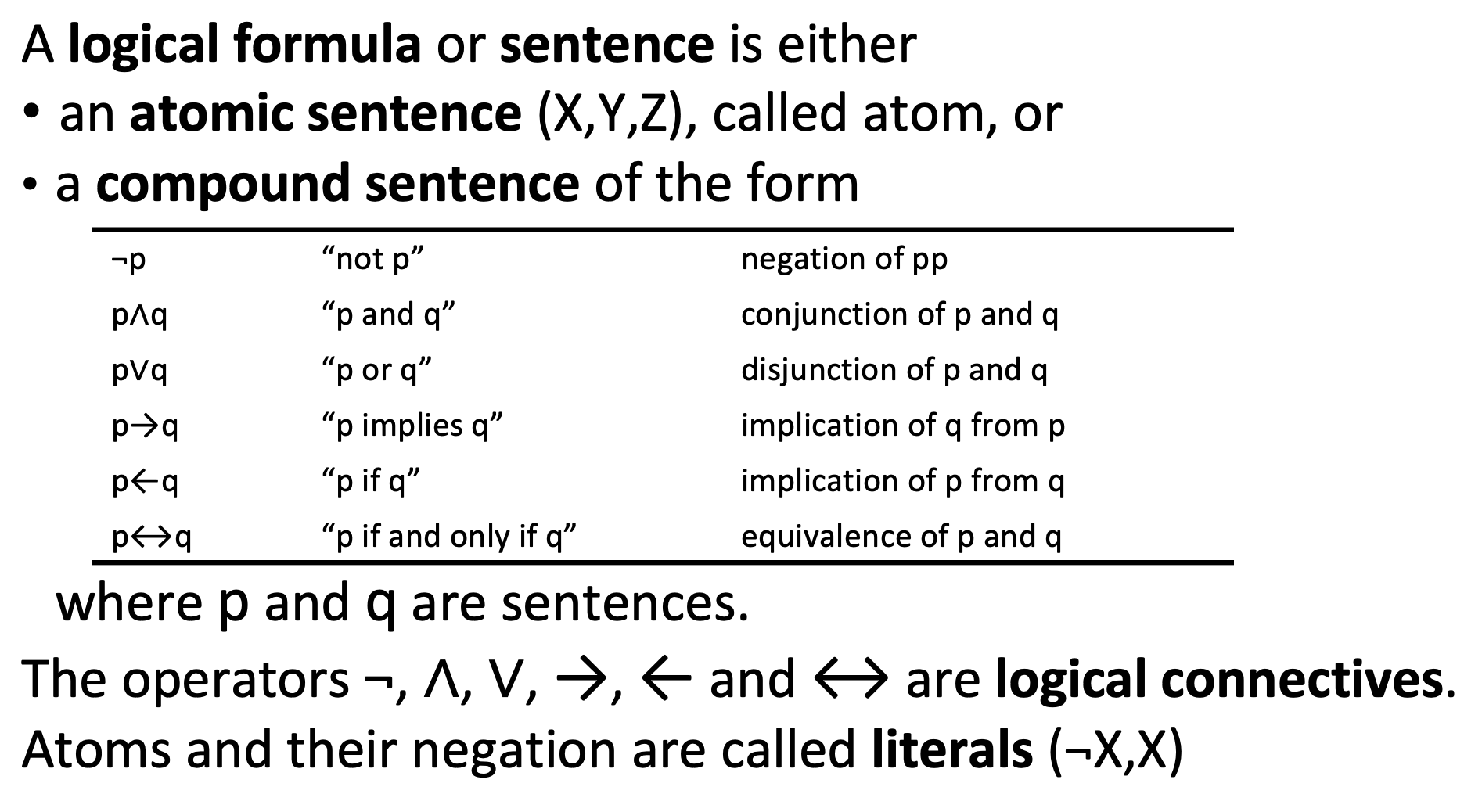
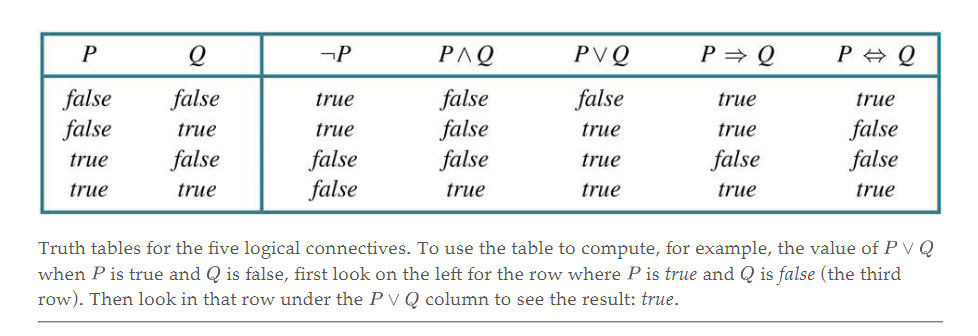
Syntax
Validity
- a statement $\alpha$ is valid if \(\forall\omega:\omega\models\alpha\)
- otherwise it is invalid: \(\exists\omega,\omega \not\models\alpha\)
Models
- a model of a logical statement is the set of worlds for which $\alpha$ holds: \(M(\alpha)=\{\omega:\omega\models\alpha\}\)
Satisfiability/Consistency
- a statement is UNSAT (inconsistent) if the statement never holds: \(\forall\omega,\omega\not\models\alpha\)
- a statement is SAT if it is not inconsistent \(\exists\omega,\omega\models\alpha\)
Relationships between Sentences
Entailment
- a statement entails another statement if: \(\alpha\models\beta\iff M(\alpha)\subseteq M(\beta)\)
Equivalence
- two statements are equivalent if \(\alpha=\beta\iff M(\alpha)=M(\beta)\)\(M(\alpha)=M(\beta)\iff M(\alpha)\subseteq M(\beta)\space AND\space M(\beta)\subseteq M(\alpha)\)
Mutual Exclusivity
- two statements are mutually exclusive if \(\nexists\omega,\space\omega\models\alpha\space\land\space \omega\models\beta\) \(M(\alpha)\not\subseteq M(\beta)\land M(\beta)\not\subseteq M(\alpha)\)
Reductions
Validity to SAT
- given $\alpha$ is valid, $\lnot\alpha$ is unsatisfiable
Entailment to SAT
Monotonicity of logic
- trying to “add” a statement to aa set of statements in not possible, i.e., the model cannot adapt
- e.g., sps \(KB\models \alpha\) and we propose some new knowledge base \(KB':=KB\land\beta\implies KB'\models\alpha\) i.e. \(KB\models\alpha\implies KB\land\beta\models\alpha\)
- adding $\beta$ to the knowledge base did not change our knowledge base, it is still at most the original KB or is smaller
Normal Forms
Conjunctive Normal Form (CNF)
- conjunction of disjunction of literals
- disjunction: $\lor$
- conjunction: $\land$
- a clause - a disjunction of literals
- the empty clause is unsatisfiable or False
- e.g., 3-SAT is a CNF
Complexity
- CNF SAT is NP-complete
- NF Validity is Linear
- disjunction of conjunction of literals
- a term (conjunctive clause) - a conjunction of literals
- the empty term = True
Complexity
- DNF SAT is Linear
- bc we could jut check if any of the disjunctions (terms) are true
- DNF Validity is co-NP-complete (NP-hard)
- conjunction of Horn clauses
- a Horn clause - a clause with $\le1$ positive literal
- a definite clause - has only 1 positive literal
Converting non CNF to CNF
- Eliminatee all bidirectional implication
- e.g. given $B\iff P_1\lor P_2$
- $(B\implies P_1\lor P_2)\land(B\impliedby P_1\lor P_2)$
- Eliminate implication: $\alpha\implies \beta\to \lnot\alpha\lor\beta$
- $(\lnot B\lor P_1\lor P_2)\land(B\lor \lnot(P_1\lor P_2))$
- Apply DeMorgan’s
- $(\lnot B\lor P_1\lor P_2)\land(B\lor (\lnot P_1\land \lnot P_2))$
- Distribute $\lor$ over $\land$
- $(\lnot B\lor P_1\lor P_2)\land(B\lor \lnot P_1)\land(B\lor P_2)$
Logical Inference
Determine \(KB\stackrel{?}{\models}\alpha\)
Enumerate Models
- truth table to infer entailment or satisfiability
- check if the worlds are modeled: \(M(KB)\subseteq M(\alpha)\)
Deduction
- We can make logical inferences over some ruleset $R$ \(KB\vdash_R \alpha\)
- Modus Ponens - if the above are true, then the bottom is true \(\frac{\alpha,\alpha\implies\beta}{\beta}\)
- E.g., Introduction \(\frac{\alpha,\beta}{\alpha\lor\beta}\)
- Add-Reduction \(\frac{\alpha\land\beta}{\alpha},\frac{\alpha\land\beta}{\beta}\)
- Require knowing the ruleset database
Refutation
- if we can prove refutation then we can prove the clause\(KB\models\alpha\iff KB\land\lnot\alpha\models false\)
Resolution
- we do so using resolution: if we have $\lnot A\lor A=\emptyset$
- e.g., \(KB=\cases{A\lor B\implies C\\A\\C\implies D}\) \(\alpha=C\)
- we want to observe \(KB\stackrel{?}{\models}\alpha\)
- we can use refutation to get the clauses: \(KB\land\lnot\alpha=\cases{\lnot A\lor\lnot B\lor C & (1)\\A&(2)\\\lnot C\lor D&(3)\\\lnot C&(4)}\)
- Then we can make some new clause using resolution: \(KB\land\lnot\alpha=\cases{\lnot A\lor\lnot B\lor C & (1)\\A&(2)\\\lnot C\lor D&(3)\\\lnot C&(4)\\ \lnot B\lor C&(1+2)(5)\\...}\)
- None of the new rule from resolution get to $false$ thus $KB\land\lnot\alpha$ is SAT, thus \(KB\not\models\alpha\)
SAT Solver (by CSP) - DPLL
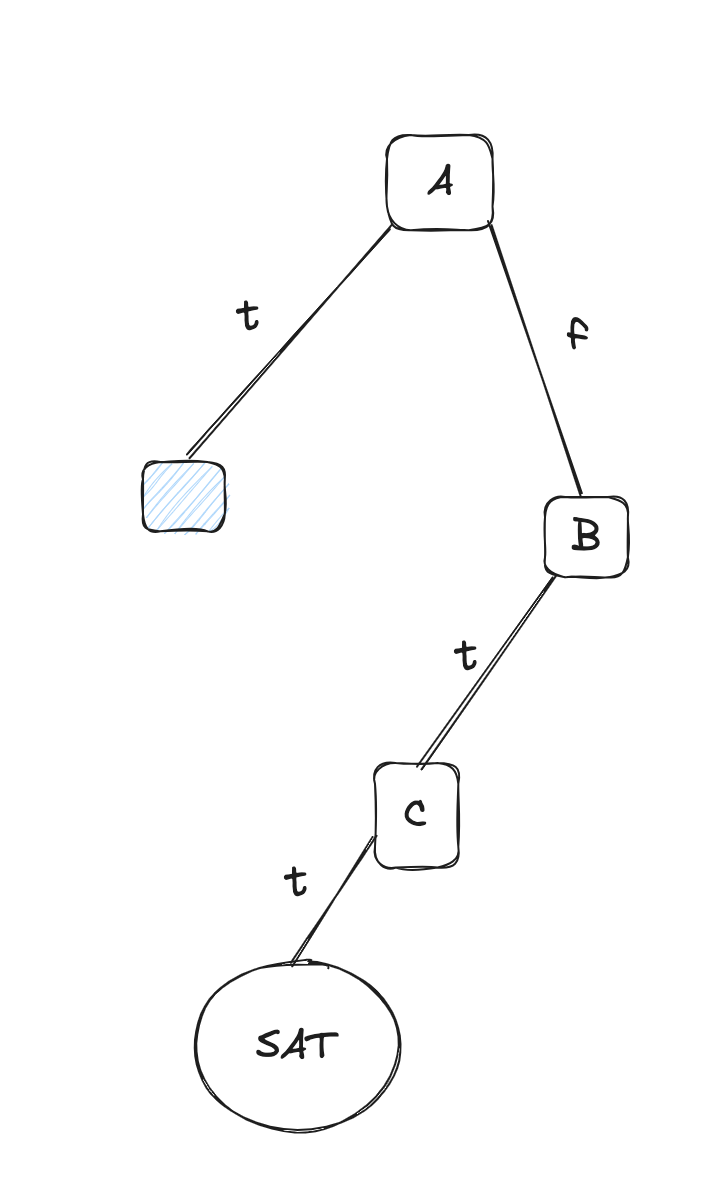
- see if we can find an assignment that makes $KB\land\lnot\alpha$ is SAT, if so then $KB\not\models\alpha$
- else, $KB\land\lnot\alpha$ is UNSAT, thus $KB\models\alpha$
- we can find this by drawing a search tree, s.t.: \(A=f,B=t,C=t\models KB\land\lnot\alpha\)
- we can also check arc consistency at each step by propagating the assigned values without taking the full branch to check for SAT