4 - Distributional Semantics
ucla | CS 162 | 2024-01-22 08:10
Table of Contents
- Vector Representations
- Term Document Matrix
- Word-Word/Context Matrix
- Cosine Similarity
- Latent Semantic Analysis
- Word2Vec Embeddings
Vector Representations
Sparse vector representations
- mutual-information-weighted word co-occurrence matrices
Dense vector representations
- singular value decomposition (and Latent Semantic Analysis)
- NN inspired models (skip-grams, CBOW)
- Brown clusters (beyond scope)
Shared intuition
- word semantics defined by similarity in usage
- modeled by embedding (vector) in a vector space
- instead of one-hot vocab-indexed vector representation, embeddings have a hyperparameter of cardinality of vector space
Term Document Matrix
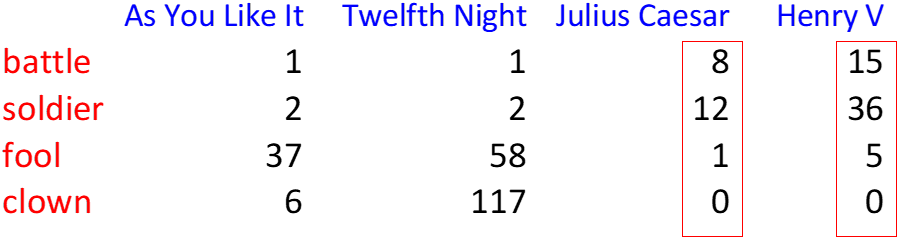
- frequency count across distinct document corpi
- each document has a count vector (column of matrix)
- 2 docs similar if vectors are similar
- each word is a count vector (row of matrix)
- two words similar if vectors are similar
Limitations
- documents can be long -> far away similar words appear to have no correlation
- limited number of documents -> word vector dims are small -> less robust across corpi
Word-Word/Context Matrix
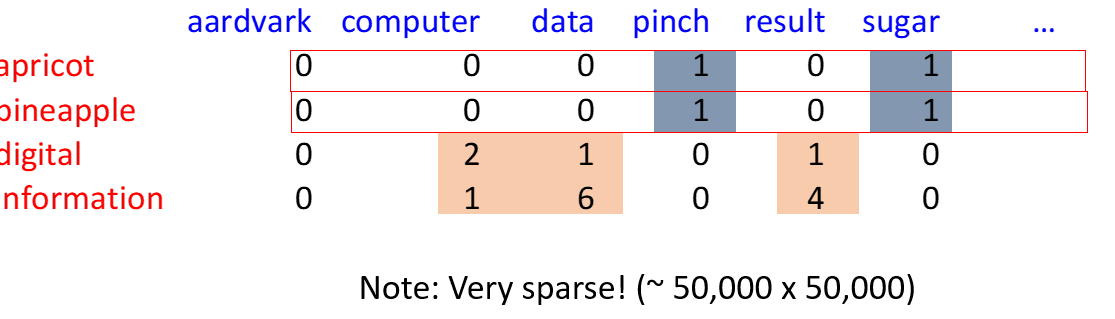
- now instead use smaller contexts (paragraphs or sliding window)
- word is defined by vector over counts of in-context words
instead of dim D -> now length $ V $ -> Matrix $ V \times V $ - word similarity if context vectors are similar
- very sparse due to dims of word vectors -> mostly 0s
- size of windows depends on goals
- small window (1-3) -> syntactic similarity
- longer windows (4-10) -> semantic similarity
- longest windows (10+) -> topical similarity
- raw counts are not good, articles are overrepresented but not discriminative
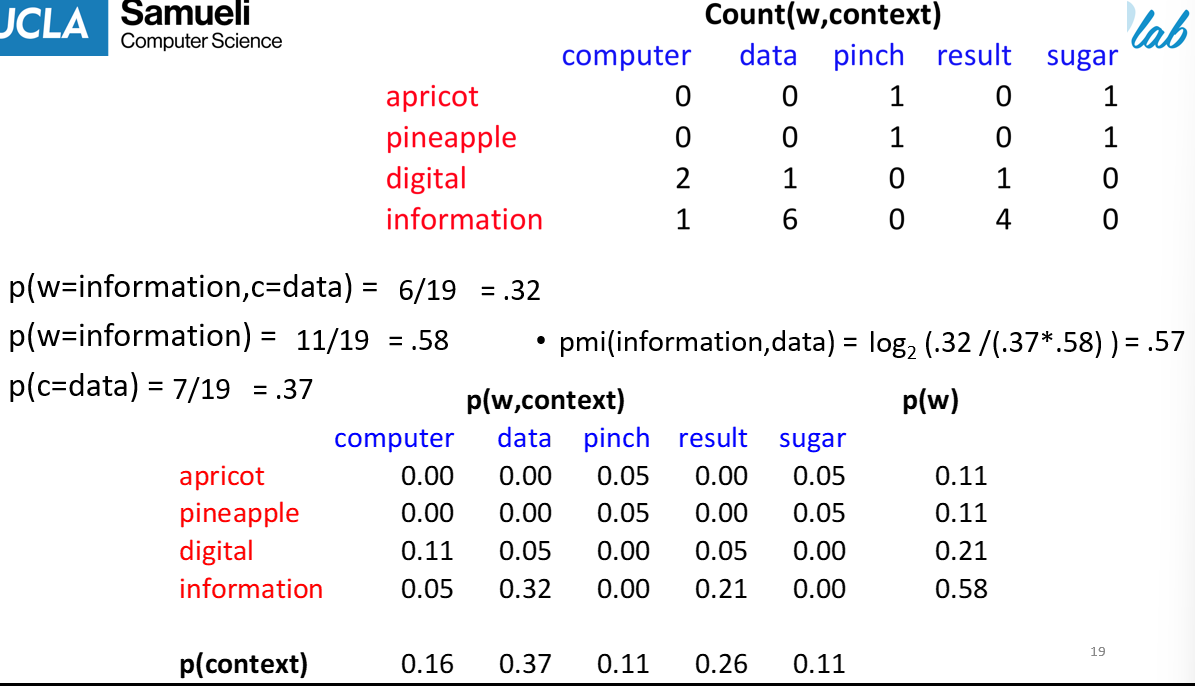
Positive Pointwise Mutual Information (PPMI)
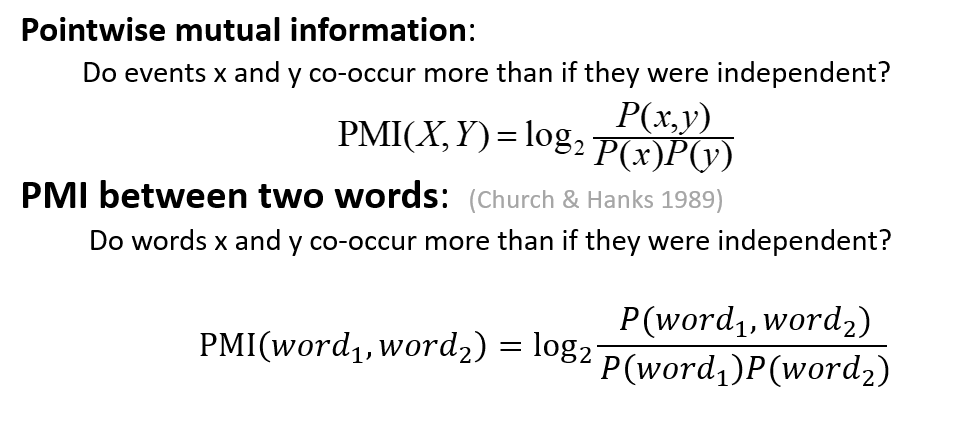
- range of PMI is $\mathbb R$ but unrelatedness is hard to understand so max to $[0,\infty)$
- Example
measure similarity as the angle between 2 word vectors $$\text{sim}\big(\vec a,\vec b\big) = \cos(\theta)=\frac{\vec a\cdot\vec b}{ \vec a \vec b }$$ - Similarity to PPMI:
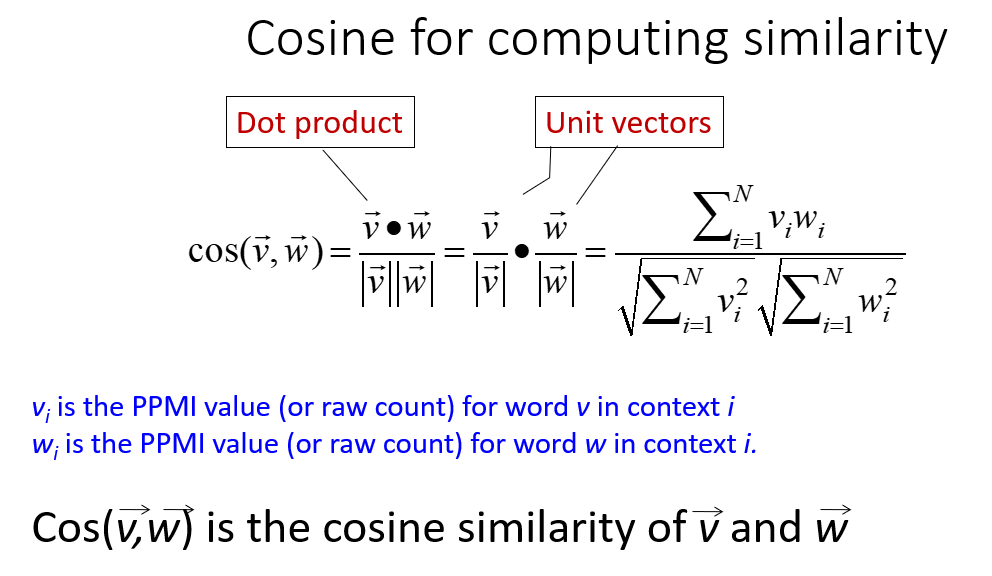
- Vector representation of similarity:
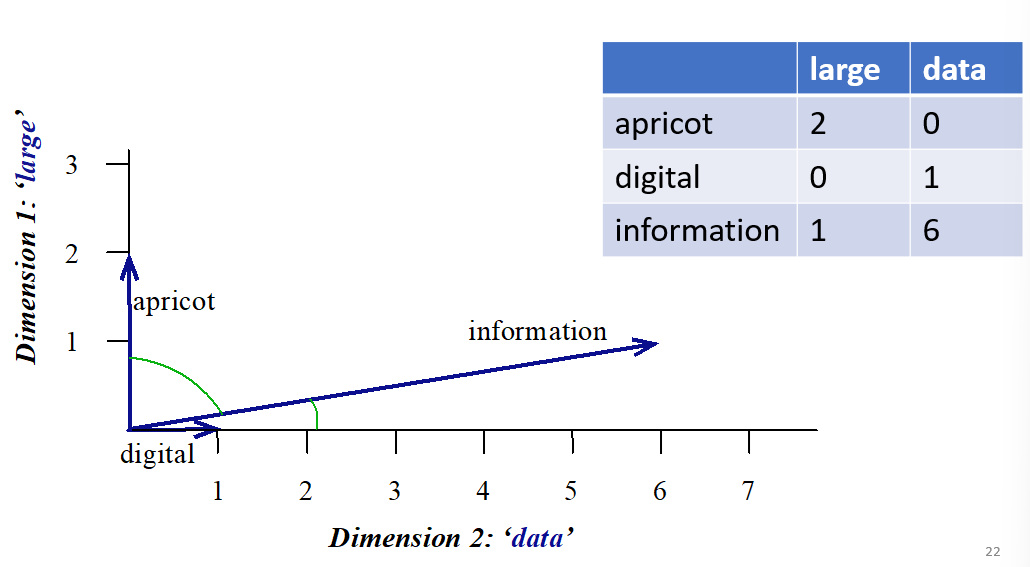
Limitations of Low-dim representations
- problems with W-D and W-W matrices
- number of basis concepts is large due to high dims
- basis is not orthogonal (lin. indep.) - not all words orthogonal for basis
- articles overrepresented -> syntax too important
Latent Semantic Analysis
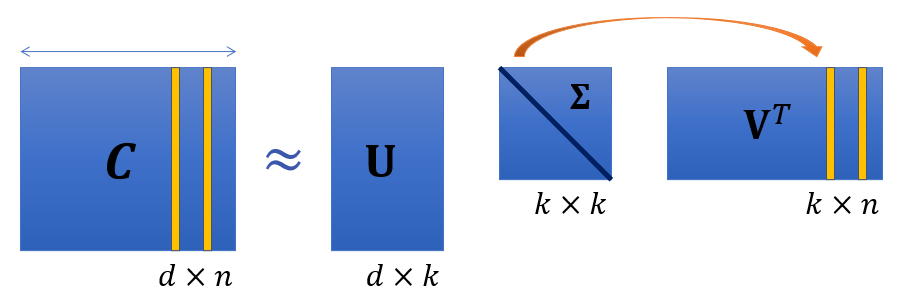
- apply Singular Value Decomposition (SVD) to decompose large dimensional context into smaller dimensional multiplications
- decompose into
UandVmatrices - unitary (orthonormal), orthogonal - dimsd x k & k x n; and $\Sigma$ matrix - diagonal, latent representation,k x k-kis the word vector dimensionality, latent dimensionality - $U,V$ matrices has eigenvalues ordered by importance like PCA
- $\Sigma$ is also ordered but of singular values
- decompose into
- creates lower dim representations of word vectors for easier computability
Word2Vec Embeddings
- start from word vectors and create a representation that is similar to LSA without having to start with co-occurrence matrices
- mainly skip-gram and CBOW (continuous BOW)
- train a NN to pred neighboring words -> allows easy training -> learns dense embeddings for words
Skip-Gram vs CBOW
- project into a hidden dense representation -> output
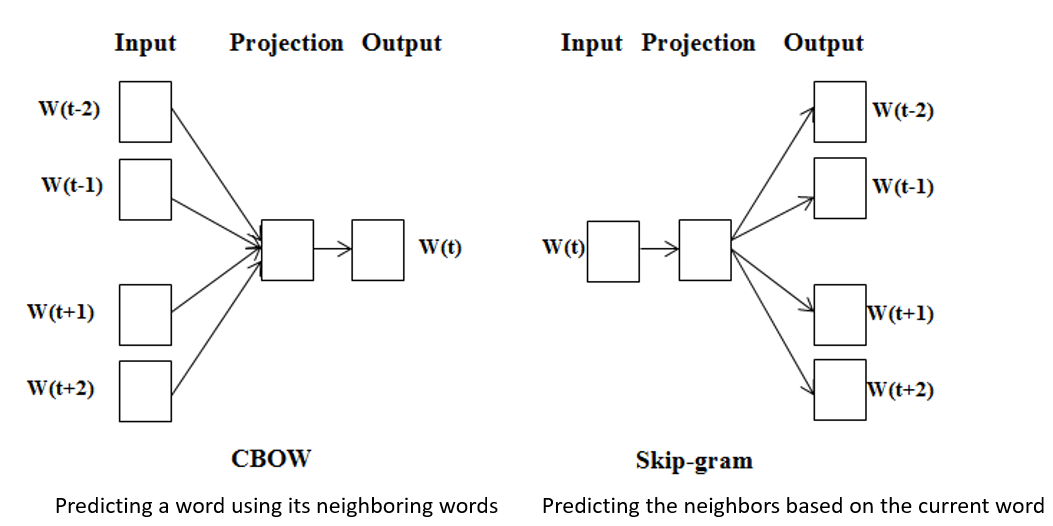
- start with initially randomized word vectors for $w_t$
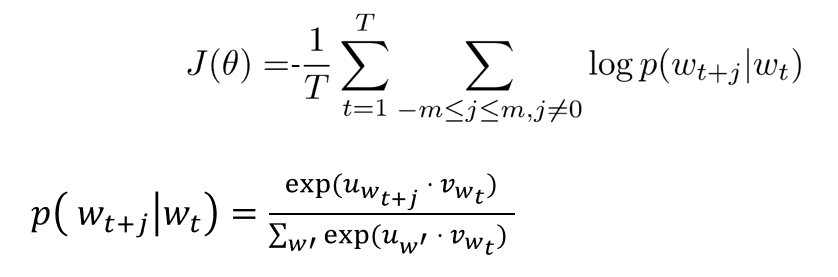
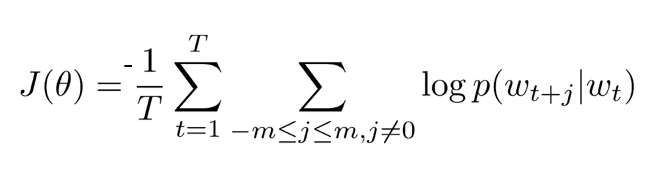
- train with the objective function
Skip-Gram Objective
- Max log likelihood (i.e. min neg) of context word $w_{t-m},…,w_{t-1},w_{t+1},…,w_{t+m}$ given center word $w_t$
- sum over neighboring words ($m$), and do this for each word in the sentence and sum ($T$)
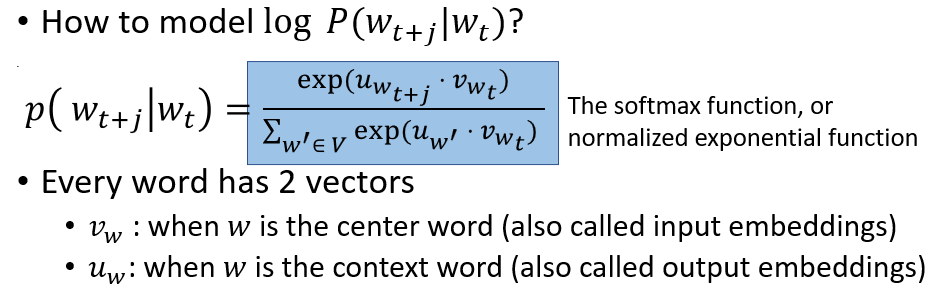
Modeling the word probs
- use log reg (softmax) and cosine similarity (dot prod)
Skip=gram Walkthrough
- $h=x^Tw_{in}$ is input embeddings; $\hat y=hw_{out}^T$ is output embeddings
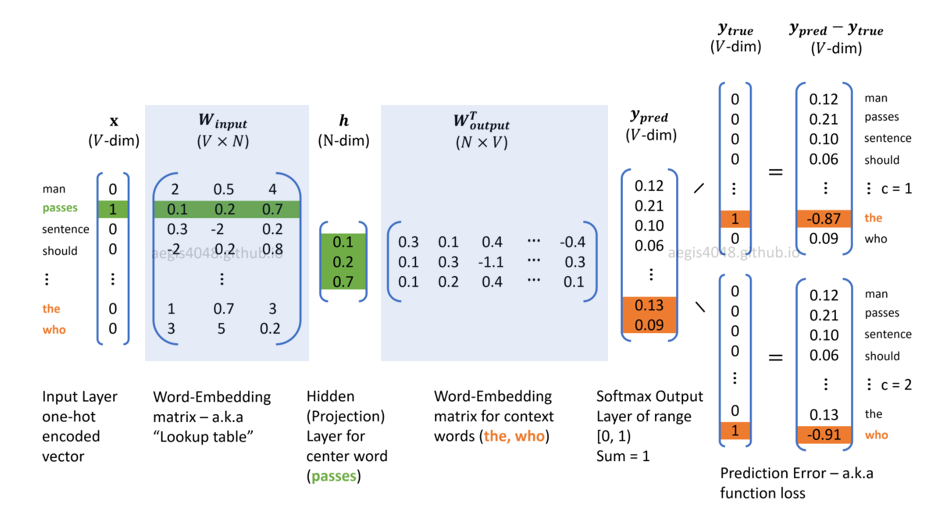
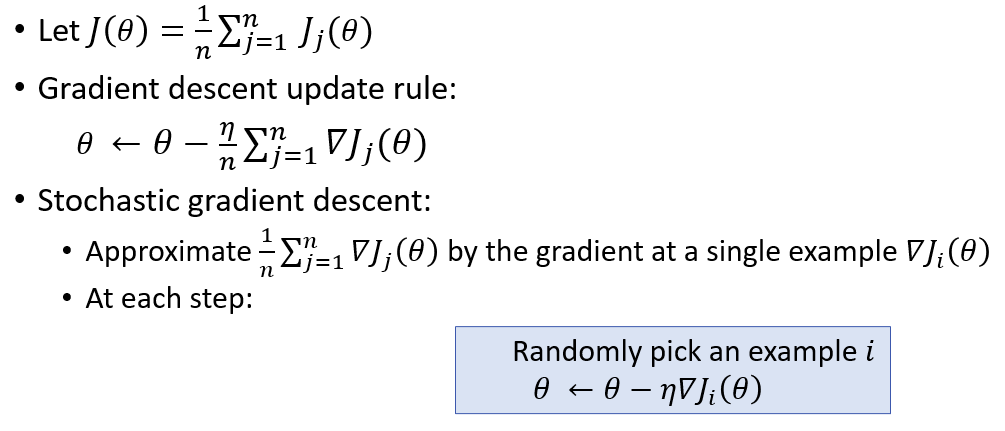
- compute loss with one-hot representation of the context words given the objective using GD:
- SGD:
Relation to LSA
- LSA factorizes co-occurrence counts
- skip-gram model implicitly factorizes a shifted PMI matrix