7 - Log Linear and Neural LMs
ucla | CS 162 | 2024-02-06 12:24
Table of Contents
Log-Linear Language Models
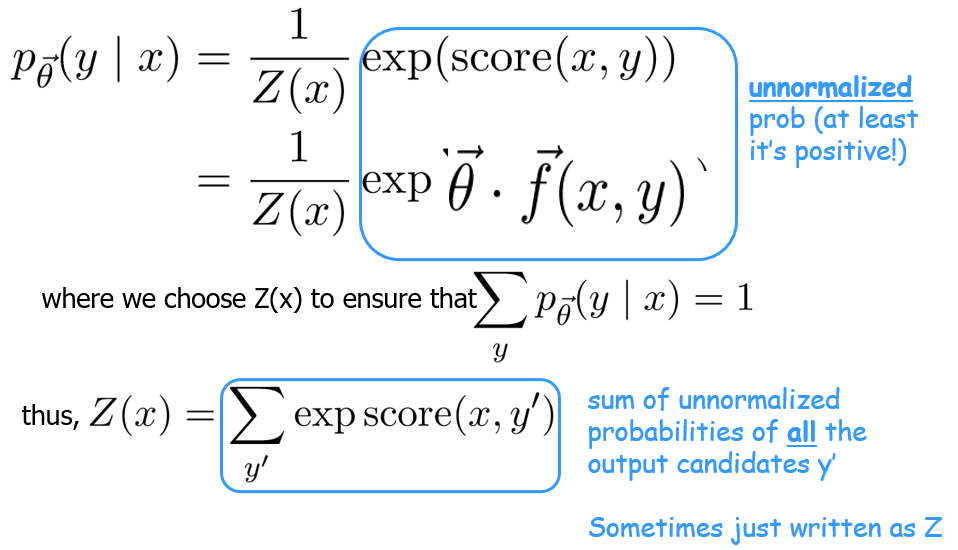
we want to create a conditional distribution $p(y x)$ from a scoring function, we define as \(\text{score($x$,$y$)}=\sum_k\theta_k\cdot f_k(x,y)=\vec\theta\cdot\vec f(x,y)\) where $\theta$ is the weight of feature $k$ and the feature function can be many representations (3.g., counts, binary, strength) - we can make the conditional probability distribution wrt the weights as
Training
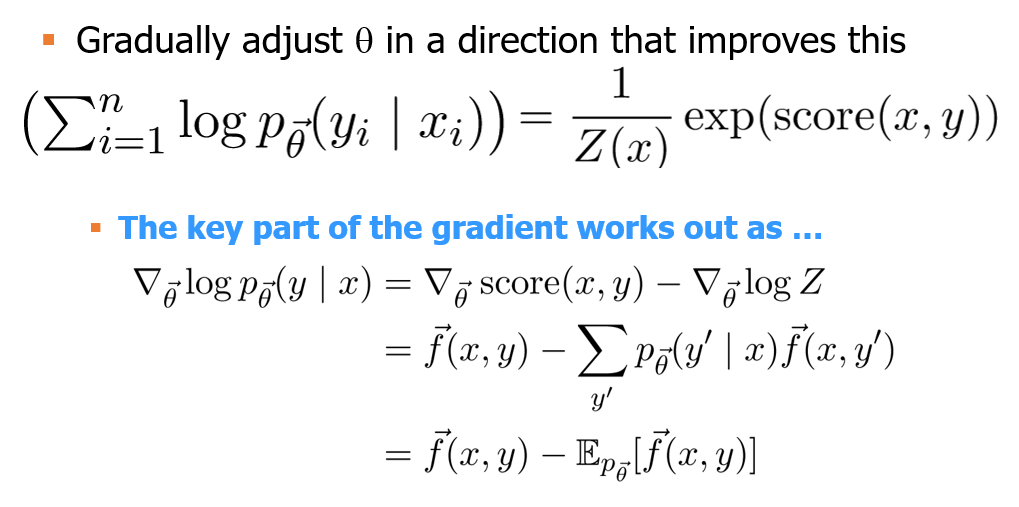
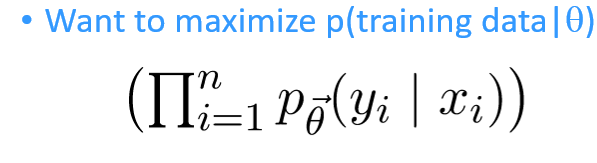
given $n$ training instances and $f_1,f_2,…$ feature functions, we maximize the log probs of training instances conditioned on the weights: $$\sum_{i=1}^n\log\space p_{\vec\theta}(y_i x_i)$$ - the thing we want to improve is make the prob dist approach the RHS
Cross Entropy
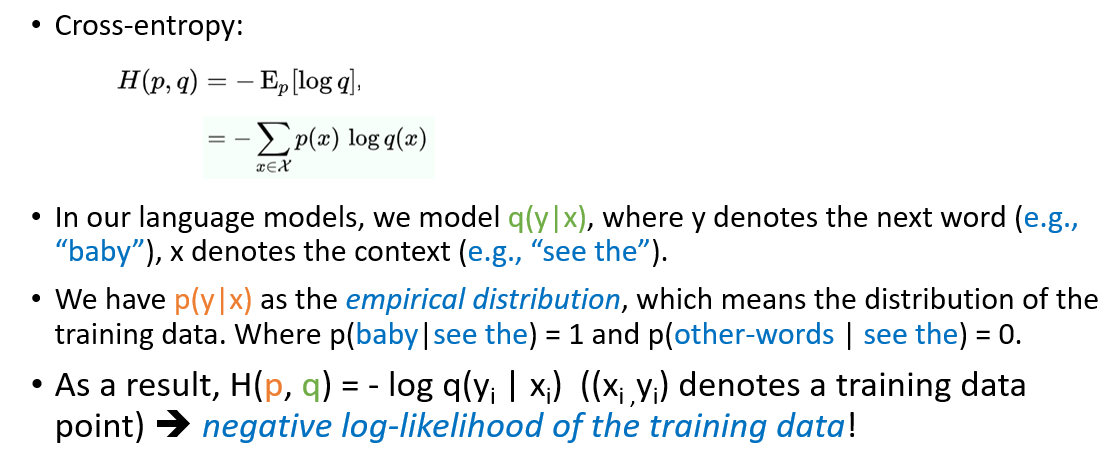
- same as neg log likelihood of our model
Generalization and OoD (unseen) samples
Neural LM
NN Review
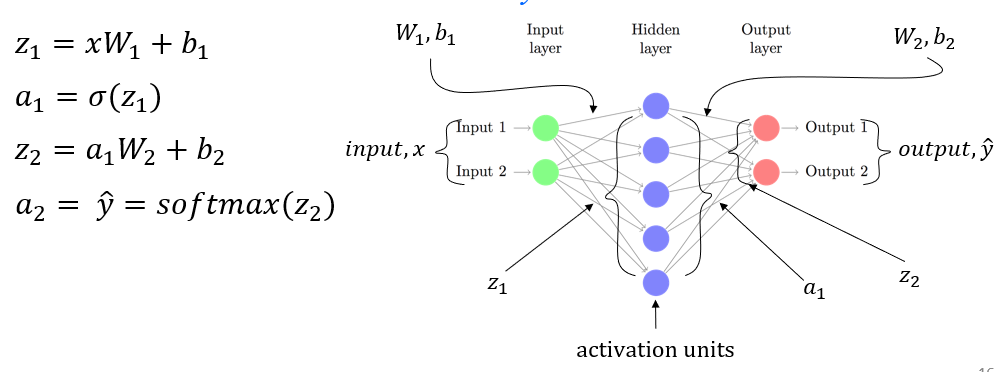
- idea for NN for LMs - FFNN (3-MLP)
- forward pass
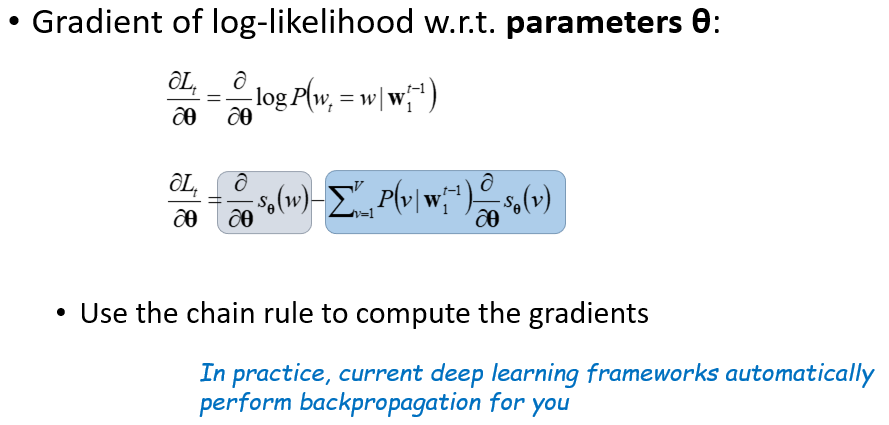
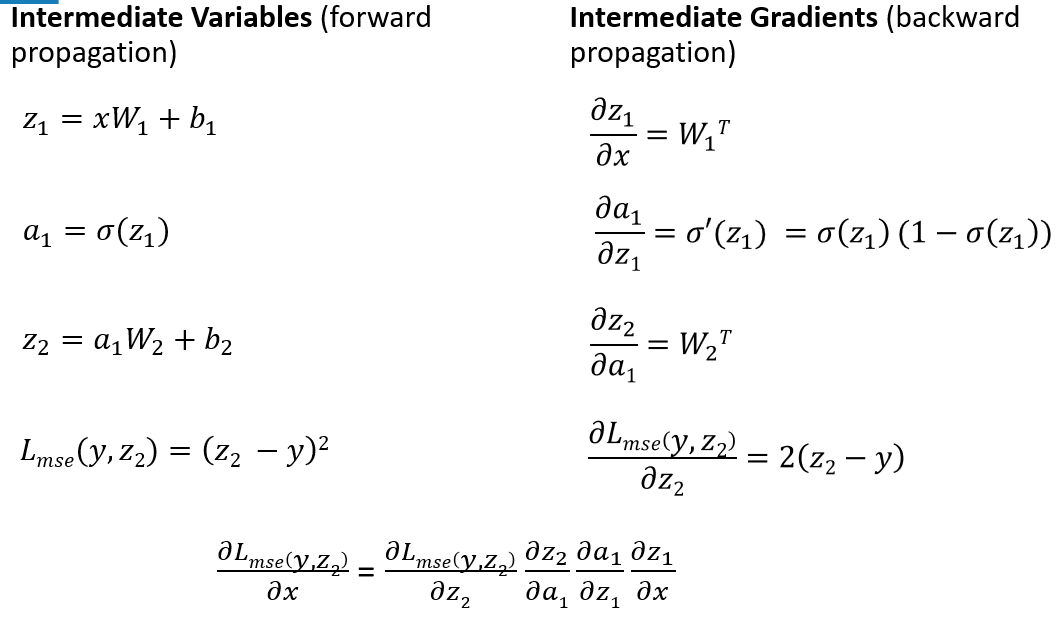
- backprop
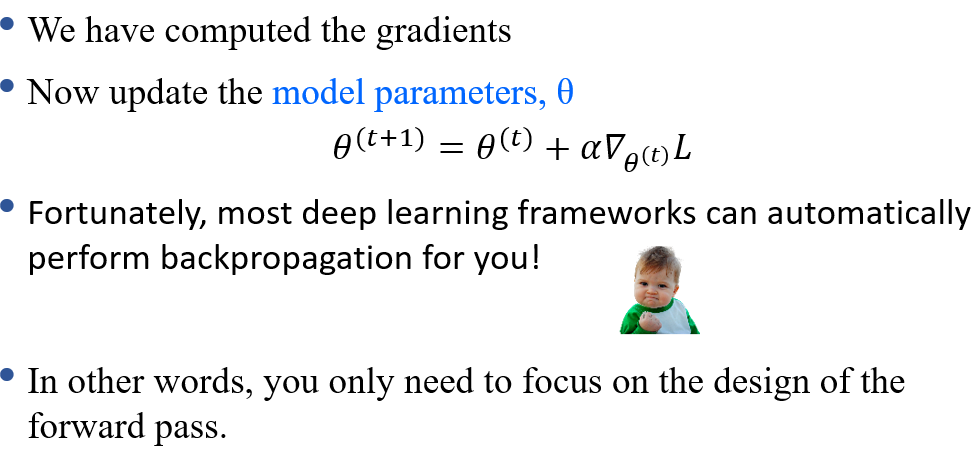
- weight update
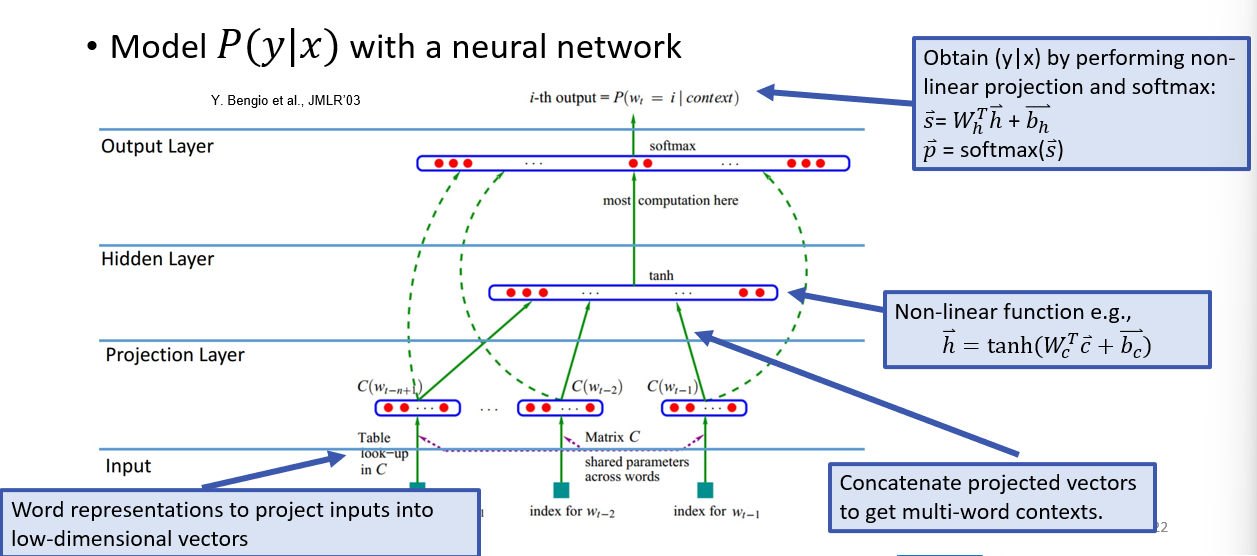
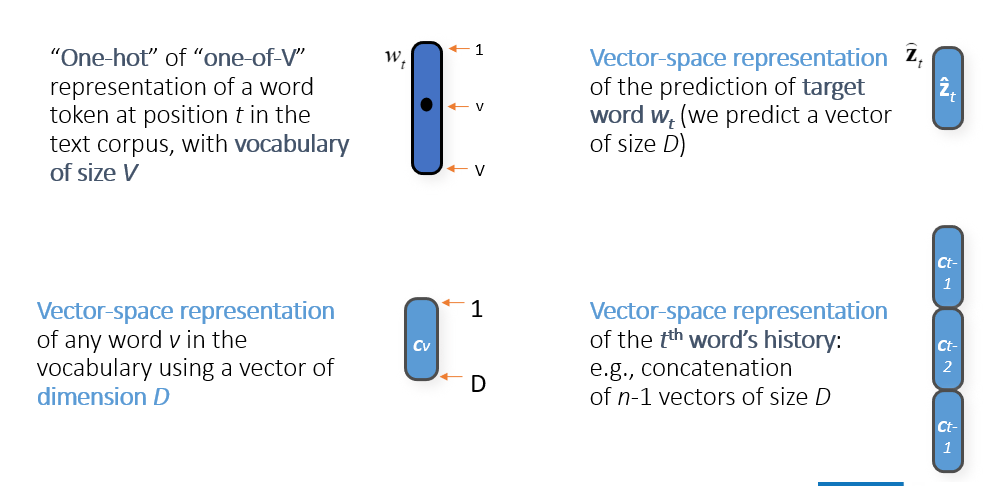
Word Embeddings
- map tokens to dense low-dim vecs to create prob dists over
- these vector representations allow similarity comparison and analogies
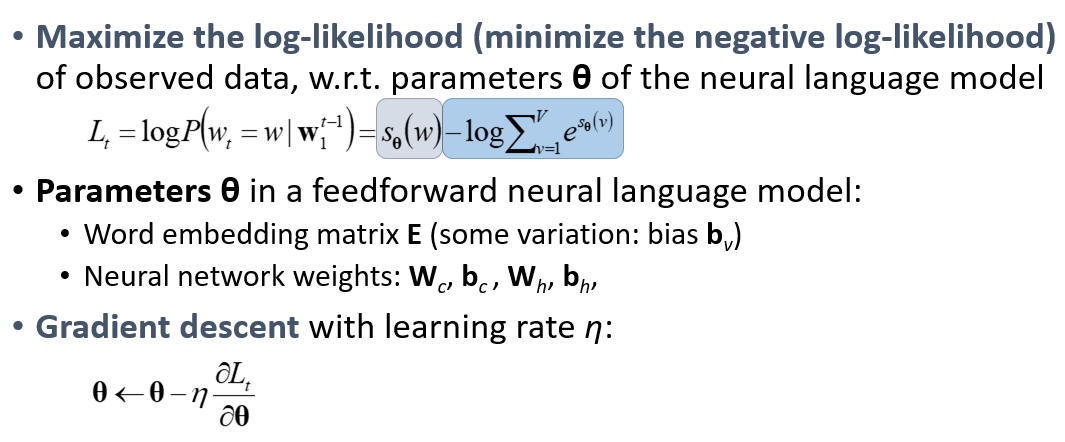
- we construct LMs in such a way to learn the model and representations i.e., update embeddings along with the weights
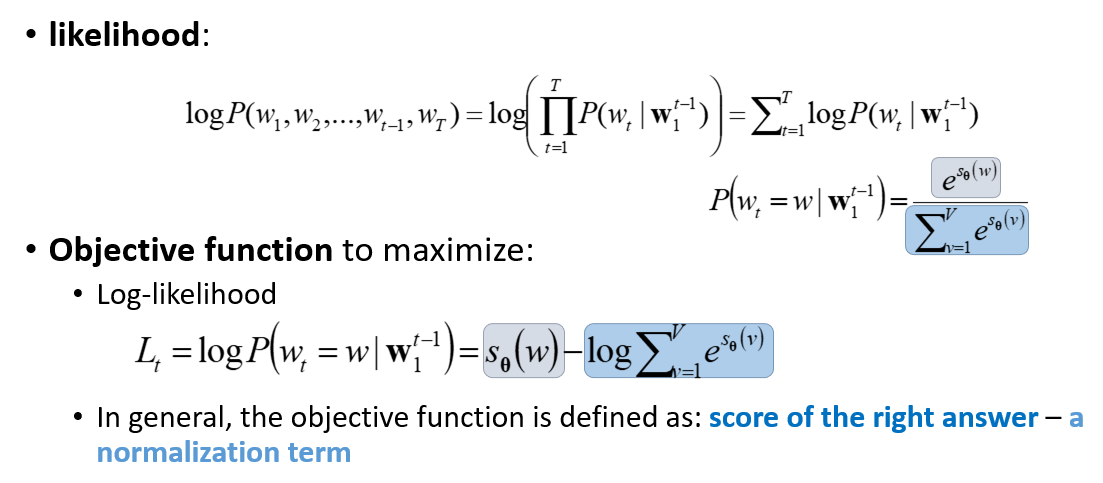
Objective Function
- likelihood is softmax, we want to maximize softmax