2 - Nondeterminism
ucla | CS 181 | 2024-04-03 15:06
Table of Contents
- Basic Notions and Examples
- Pattern Matching Examples
- Formal Definition
- Equivalence of DFA and NFA: Conversion NFA -> DFA
Basic Notions and Examples
- NFAs may have any number of transitions on a given symbol (i.e. multiple paths from the same symbol of the alphabet)
- NFAs may transition wo consuming a symbol and isntead transitioning on $\varepsilon$ to another state
- NFAs accept a string if there is at least 1 path that accepts
- useful for pattern matching
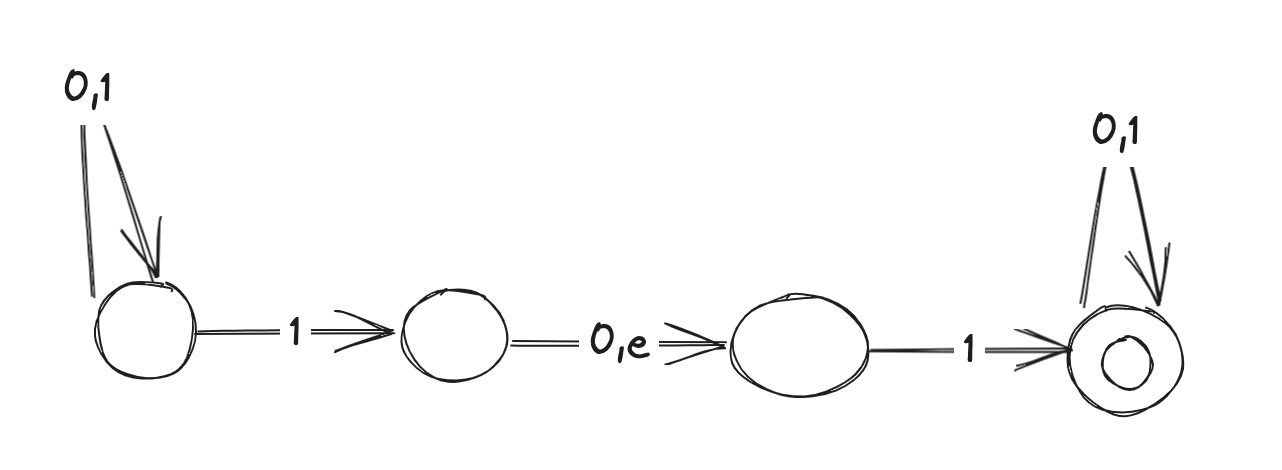
- e.g. L(M) = strings containing 11 or 101:
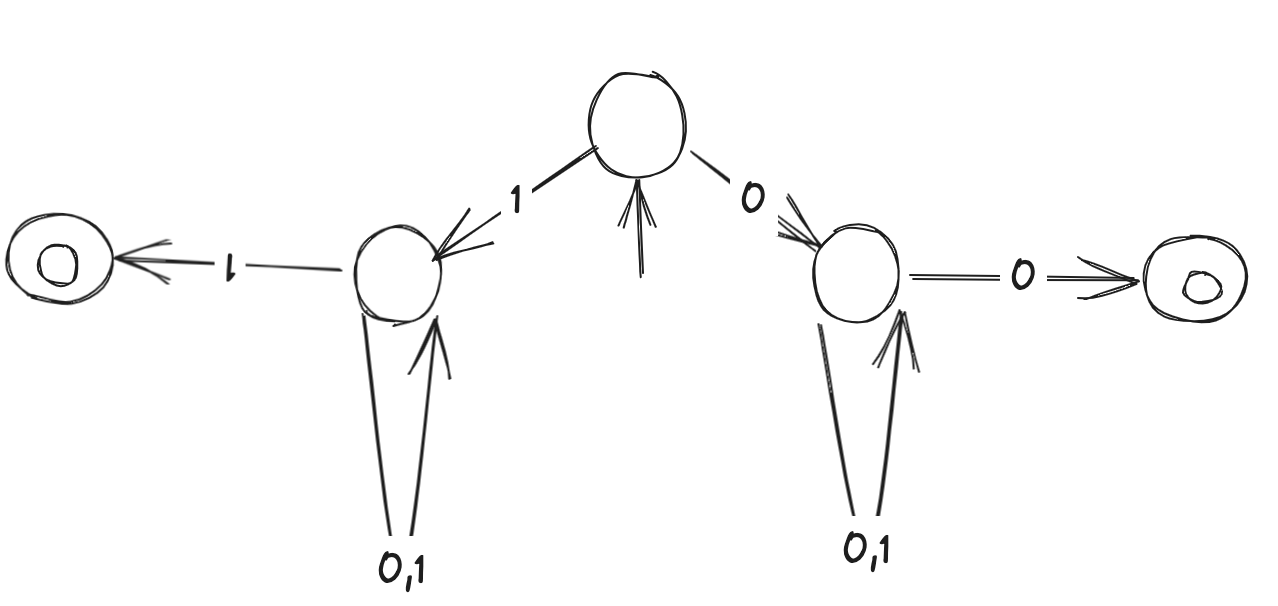
- e.g. L(M) = strings of length >= 2 and starts and ends in the same symbol:
Pattern Matching Examples
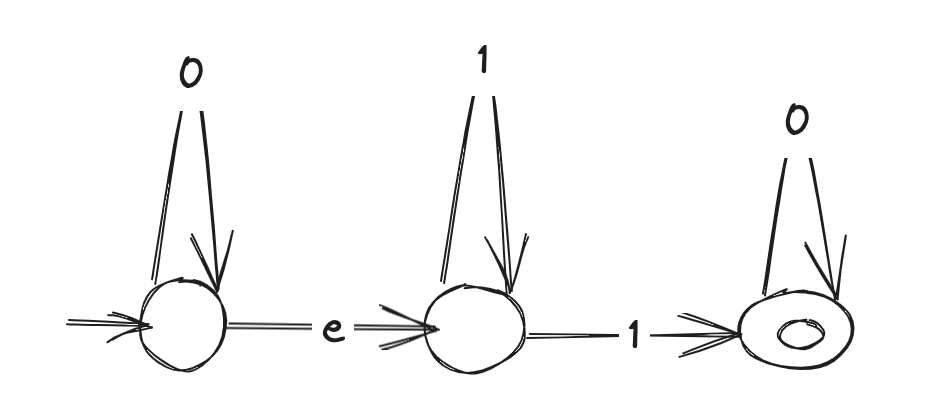
- L(M) = string of regex 0*1*0+ (any number of 0s followed by any number of 1s followed by at least one 0):
Formal Definition
\(M=(Q,\Sigma,q_0,F,\delta)\) only difference is the transition returns a set of states and can take an epsilon input: \(\delta:Q\times\big(\Sigma\cup\{\varepsilon\}\big)\to P(Q)\) where $P(Q)$ is the Power set of Q, i.e. the set of all possible combinations of sets in Q The model accepts a string if there exists at least 1 path from start to an accepting state and the string ends on a final state.
Equivalence of DFA and NFA: Conversion NFA -> DFA
Theorem: Every NFA $N$ can be converted to a DFA $D$ that recognizes the same language $L$
- Allow DFA states to represent a et of NFA states
- Make transitions over the alphabet for each DFA state, recursively (i.e., do this for all new/unique DFA states we generate)
- If the NFA state transitions nowhere, then DFA should transition to a trap state (dead state, denoted $\emptyset$)
- Label final states of DFA as any states that contain final states of NFA
- Remove unreachable states
Given an NFA $N=\big(Q,\Sigma,\delta,q_0,F\big)$, the equivalent DFA is defined as \(D=\big(P(Q),\Sigma,\Delta,S_0,\mathscr F\big)\) $S_0={q\in Q\space:\space q\text{ is reachable from }q_0\text{ via a path }\varepsilon^}$ $\Delta(S,\sigma)={q\in Q\space:\space q\text{ is reachable from a state in } S\text{ via a path }\sigma\varepsilon^}$ $\mathscr F={S\subseteq Q\space:\space S\text{ contains a state in }F}$
Equivalence: $N$ accepts a string $w=w_1…w_n$ $\iff$ a state in $F$ is reachable via a path $\varepsilon^w_1\varepsilon^w_2…w_n\varepsilon^*$ $\iff$ a state in $\mathscr F$ is reachable from $S_0$ via the path $w_1…w_n$ $\iff$ $D$ accepts $w$
Proving Complexity
Thm: An (smallest) NFA w/ $k\in\mathbb Z^+$ states can always be converted to a DFA w/ $\ge 2^k$ states Thus, the smallest DFA has some $k\le n\le 2^k$ states
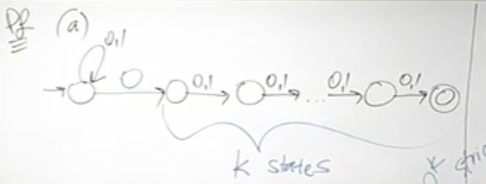
- We prove this by considering a language s.t. $\exists NFA$ w/ $k+1$ states and NO DFA w/ $\lt 2^k$ states (pf by contradiction, so consider that the DFA accepts w/ $\lt 2^k$ states)
- e.g., L is the language for which there is a 0 in the $k$th position from the end over the binary alphabet
- The NFA w/ k+1 states:
- then for the DFA, there are $2^k$ unique inputs possible, but if the DFA has strictly $\lt 2^k$ states, then the final state for the inputs cannot be unique for all inputs by the P.P.
- i.e., $\exists$ $k-$length strings $u,v$ for which $u\neq v$ but final state of $u=$ final state of $v$
- suppose the unique identifier in the strings is that $u_i=0,v_i=1$ and all other characters in the string are the same
- Now because they share the same end state (i.e. they converge at the end), appending $i-1$ 0s to the end of either string will still have the same end state $\implies u0^{i-1}$ ends on the same state as $v0^{i-1}$ (they both have 0 in the $k$the position because they are in the language)
- Now consider that both $u,v$ are length $k$ so after position $i$ (the character for which they differ), there are $k-i$ characters following the $i$th position symbol
- Now if we consider the 0-extended strings, they have $(k-i)+(i-1)=k-1$ values after the $i$th position, thus $k$th position = $i$th position => $v\notin L$ b/c it has a $1$ at $v_i=v_k$
- This contradicts the fact that both $u,v$ the DFA ends them on the same final state (Accepting or rejecting we don’t know but this regardless contradicts the definition of the DFA on $L$)