2 - Text Classification
ucla | CS 162 | 2024-01-11 23:26
Table of Contents
Classifiers
Rule Based Classifier
- doesn’t generalize, but good for specific corpuses
Supervised Classifier
- takes inputs $\vec x$ from the corpus and labels $y$ per input as a class and learns from supervised training
- vecotrized: $X=[\vec x_1,…,\vec x_n]$, $Y=[y_1,…,y_n]$
- a classifier $C:\vec x_i\to y_i$
- a learner $L:X\times Y\to C$
Probabilistic Classifier
logits = log probs of $p(y \vec x)$ we want our classifier to output $\text{argmax}_y\space p(y \vec x)$ - i.e. return the label with the highest probability of being correct and create a model that does this for the most inputs correctly
Creating the model
- the distribution is a multinomial distribution because of the many classes
- we want to find a direct MLE (maximum likelihood estimation) https://blog.jakuba.net/maximum-likelihood-for-multinomial-distribution/
- i.e. the MLE is the word’s frequency in the corpus so its a terrible estimator because the prediction space is exponentially large
- so we make model assumptions
Bag of Words (BoW) Assumption
assume the order of words does not matter i.e. $$p(y \text{“Filled with horrific”})=p(y \text{“with”,”horrific”,”filled”})$$ - this sets the inputs as a set instead of a sequence
- however this simplifies the problem but introduces new issues in positional context
- but this is still not enough because this represents the sentences as a set but the likelihood this occurs in the corpus is still incredibly low
Naive Bayes Assumption
- words are independent conditioned on their class
i.e. the bayes independence formula $$p(\text{“Filled”,”with”,”horrific”} y)=p(y)\prod_{x_i\in \vec x} p(x_i y)$$ - now we reduce the space to the vocab size (from the corpus to unique words) (from $O(V^n)$)
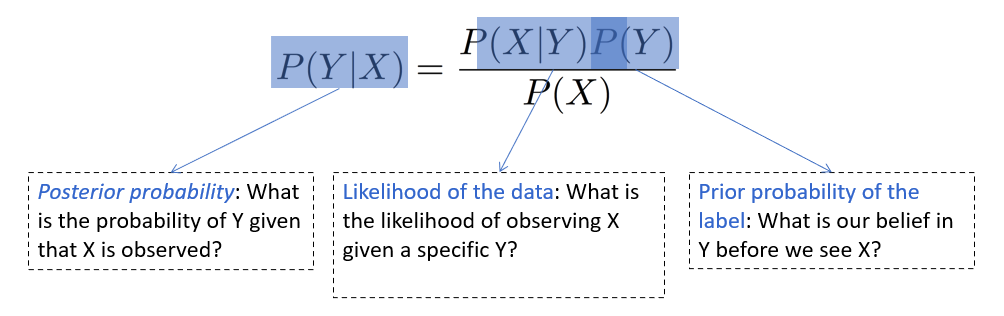
now to find $p(y \text{filled,horrific,with})$ can be solved with bayes rule due to the above assumption to allow us to find each words probs - both assumptions brings us to
- simplification brings us to:
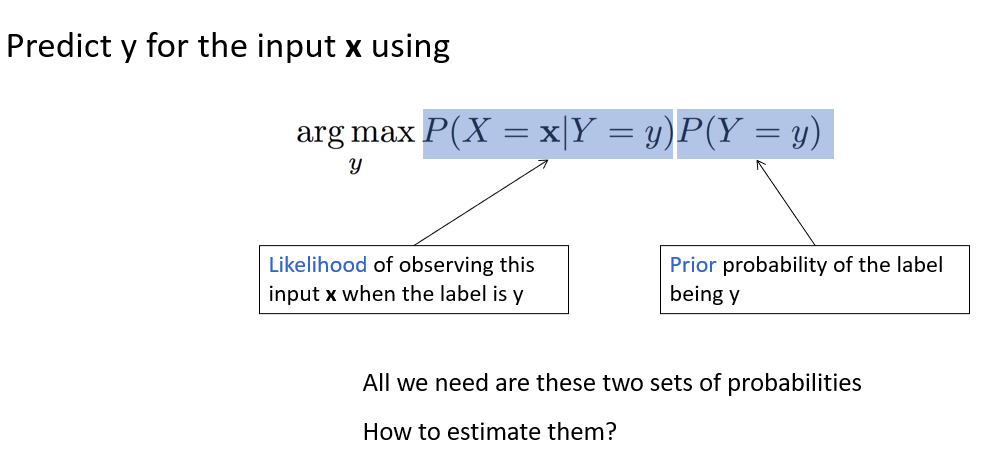
- the prior is the frequency of the label from the multinomial distribution
- the likelihood can be found by counting the occurrences of X=x when Y=y and divide by the overall number of times Y=y
Complexity
- initially $k-1$ parameters for $k$ classes and $V^n-1$ parameters for $V$ vocab size, the last class and word can be found from not being in the parameters
- now we have only $k(V-1)$ overall parameters
Naive Bayes Classifier
- using all of these assumptions we can make the following classifier
- assume features (words in sentences) are conditionally independent given the label $y$
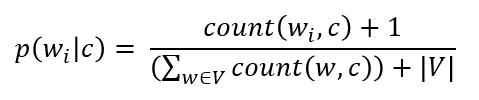
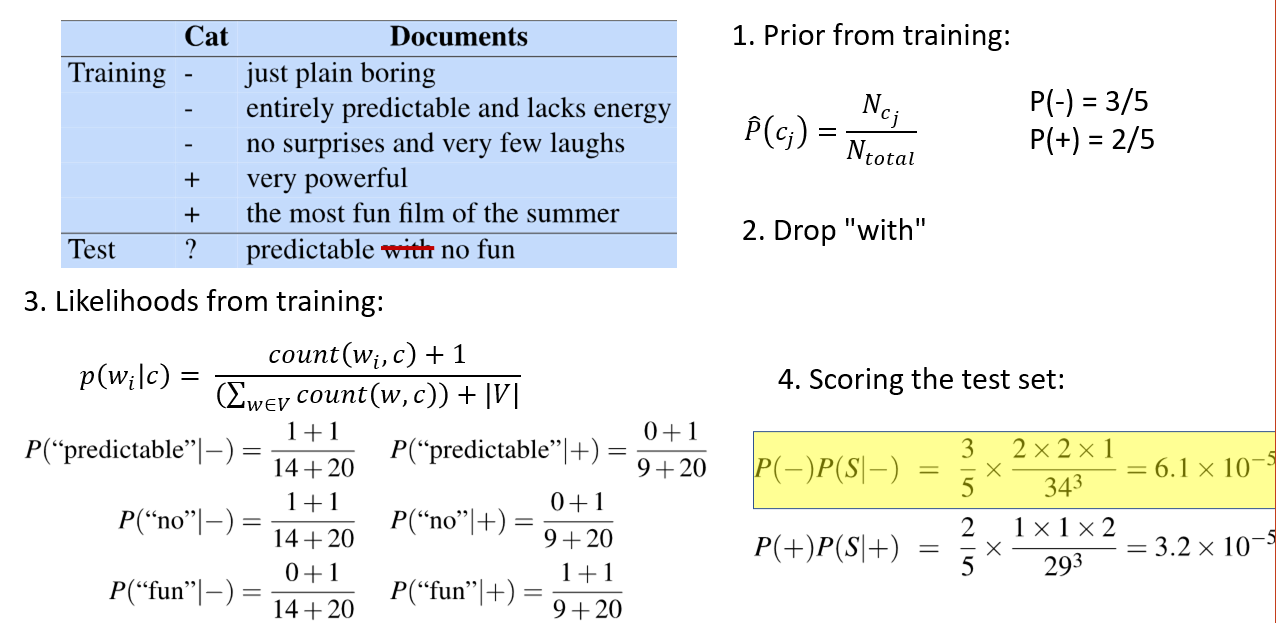
to predict we need the prior $p(y)$ and the likelihood for each $x_j$ for $p(x_j y)$, then we have the prediction (hypothesis): $$h_{NB}(\vec x)=\text{arg}\max_y\space P(y)\prod_j P(x_j y)$$ - where the term in the prod is (note here we add smoothing for 0 counts)
Learner for NB classifier
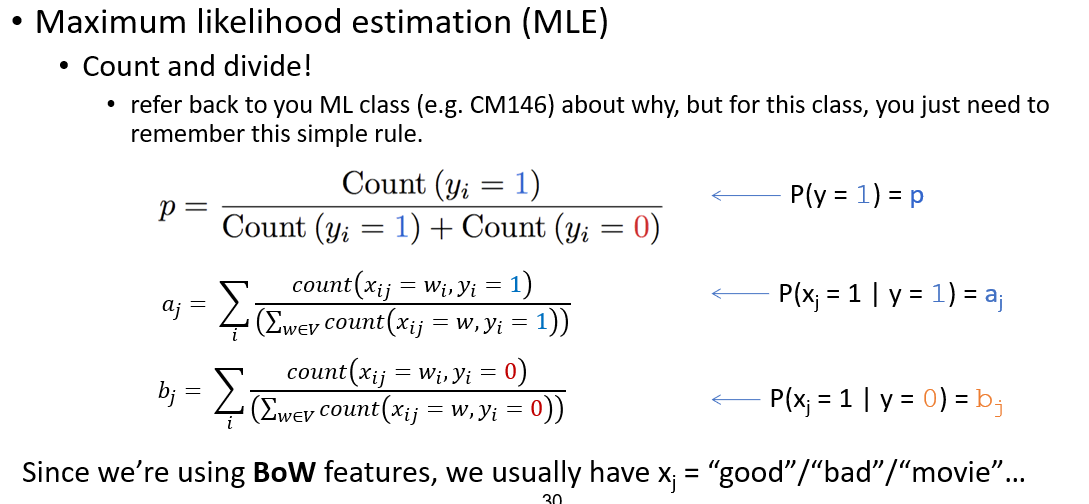
Prediction
- for prediction we can drop tokens/words that are not in our test input
we can also supply smoothing (regularization) by +1 to numerator of likelihoods and +$ V $ to denominator - for the denominator likelihood counts, we count the number of words that occur for each label ocurrence

Practicalities
Log Probs
- large vocab size multiplying bayes probs will cause underflow
- instead use logits to represent multiplication of words by probs into sum of log probs
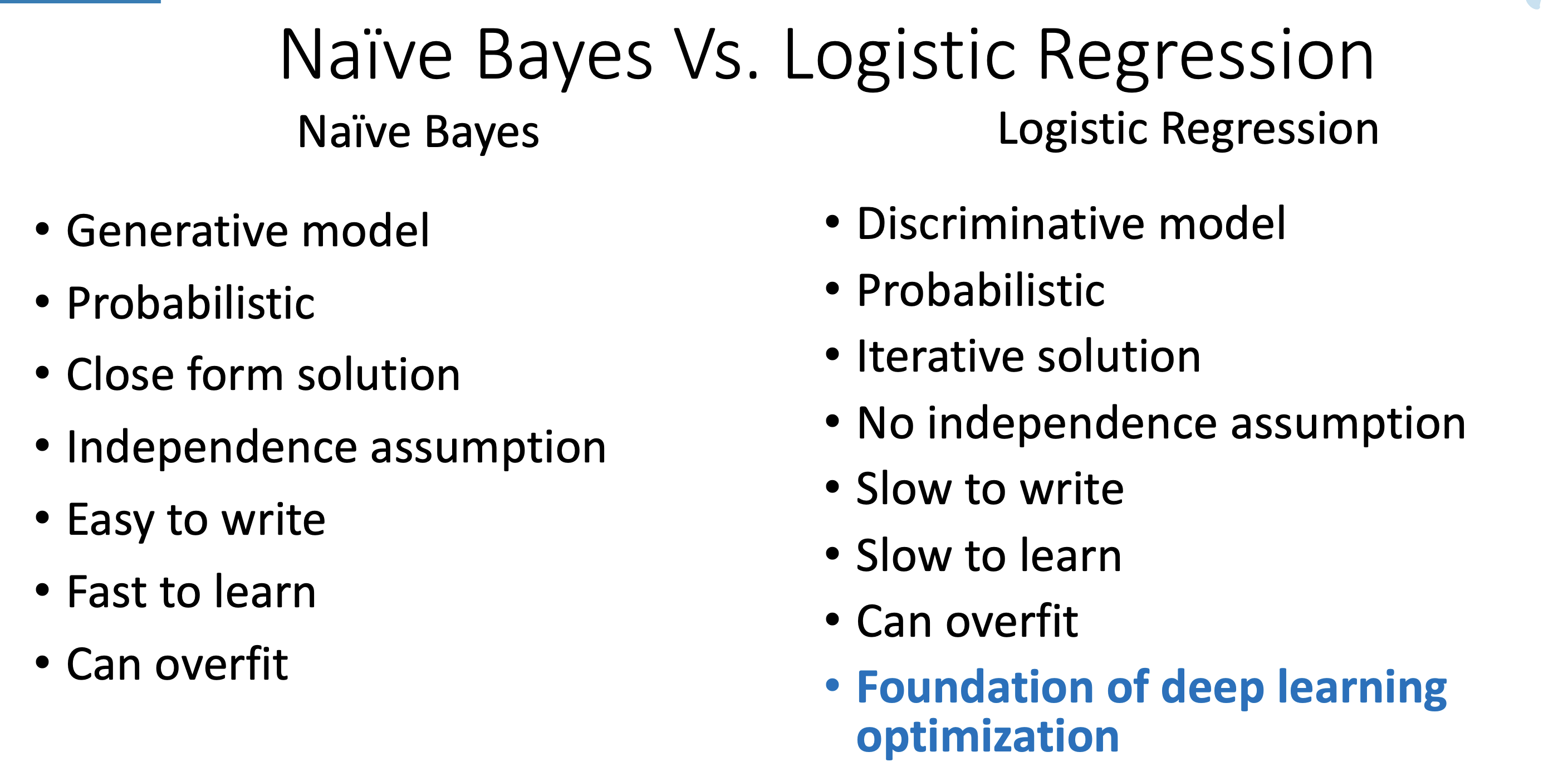
- Generative models learn a joint probability distribution $p(\vec x,y)$
Discriminative models learn a conditional probability distribution $p(y \vec x)$ naive bayes learns $p(\vec x y)\propto p(\vec x,y)$ so its really generative so to make $p(y \vec x)$ from our current naive bayes model, we can assume a scoring function for a text instance and its label $\text w^T\Phi(\vec x,y)$ - here the weights are $\text w^T$
- the feature function $\Phi(\vec x,y)$ is a score not a probability and returns a vector
- multiplying the 2 gets a scalar
- we can then take the exponent of the function to make the range $(0,\infty)$ and monotone (nondecreasing)
- then we can model it is as softmax (or multiclass logistic regressor)

- now we can treat this as a prob maximization by picking best weights
Feature Engineering
- now given the feature function we need to do some feature selection for $\Phi$
- n-grams for sequence information
- punctuation, text length, etc.
- then we use a MLE to find max weights
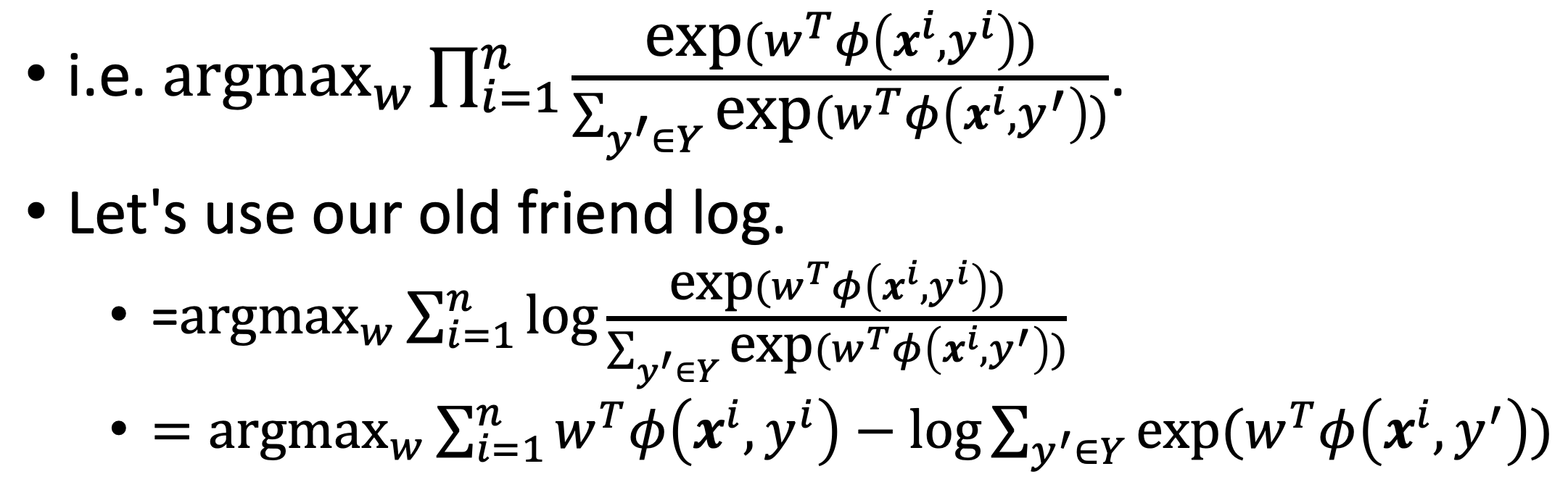
- this is ongruent to mnimizing the negative log likelihood of

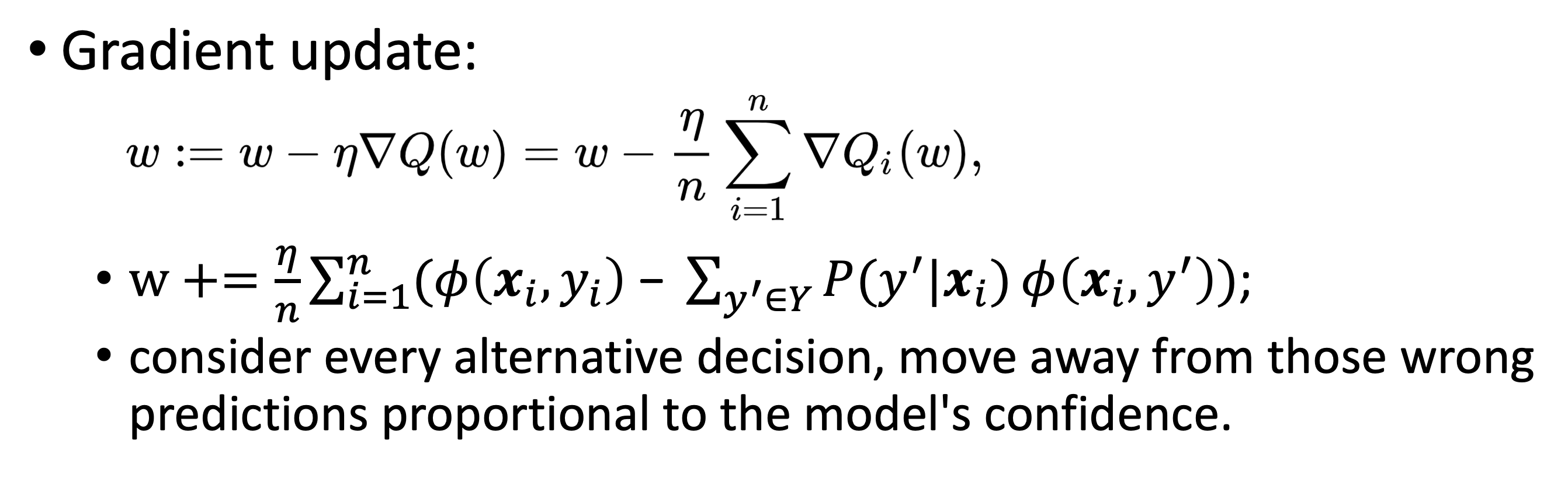
- now wee use gradient descent
Log Reg Gradients
- the gradient is:
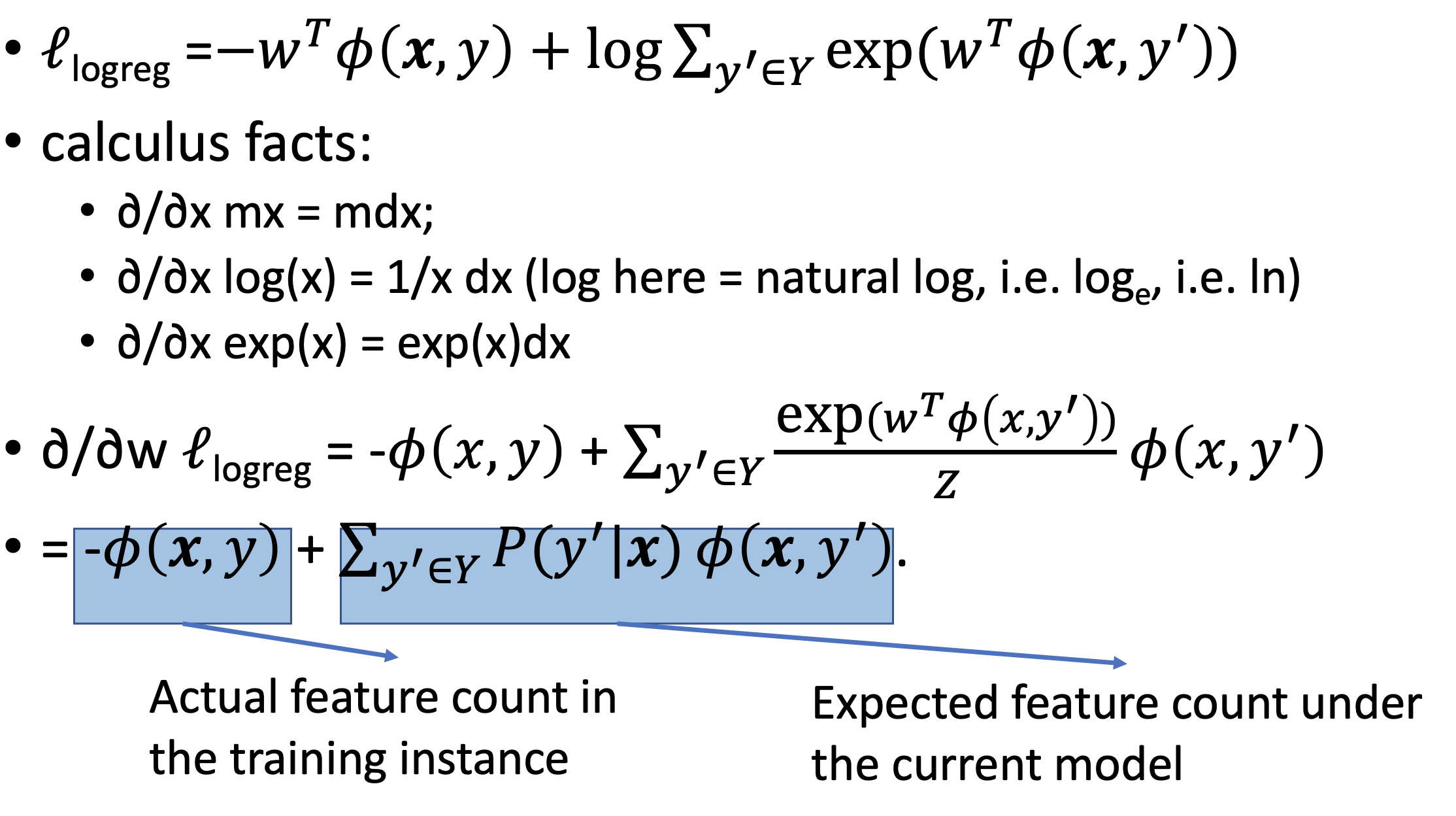
- where z is the sum over the classes ie the 2nd part of the loss
- and the weight update is:
Differences