2 - Display Technology
ucla | CS 174A | 2024-01-11 19:06
Table of Contents
Output Devices
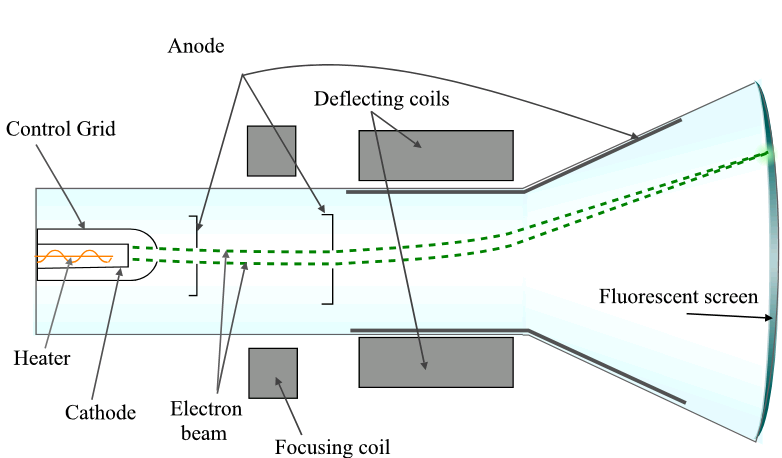
Cathode Ray Tube (CRT)
- electrons strike a Phosphor coating and emits light
- electron gun launches electrons
- electron direction controlled by deflection plates to target a direction on the Phosphor coating
- random-scan, calligraphic, or vector CRT displays - just draw lines cant fill
- refresh rate of 60 hz - 85 hz
- issue - cant rasterize images - cant create solid shapes
Raster CRTs
- framebuffer depth:
- 1 bit = b/w image either filled or not
- 8 bit = grayscale with 256 possible shades of b/w
- 8 bit per RGB = 16M colors
- 12 bits per color = HD
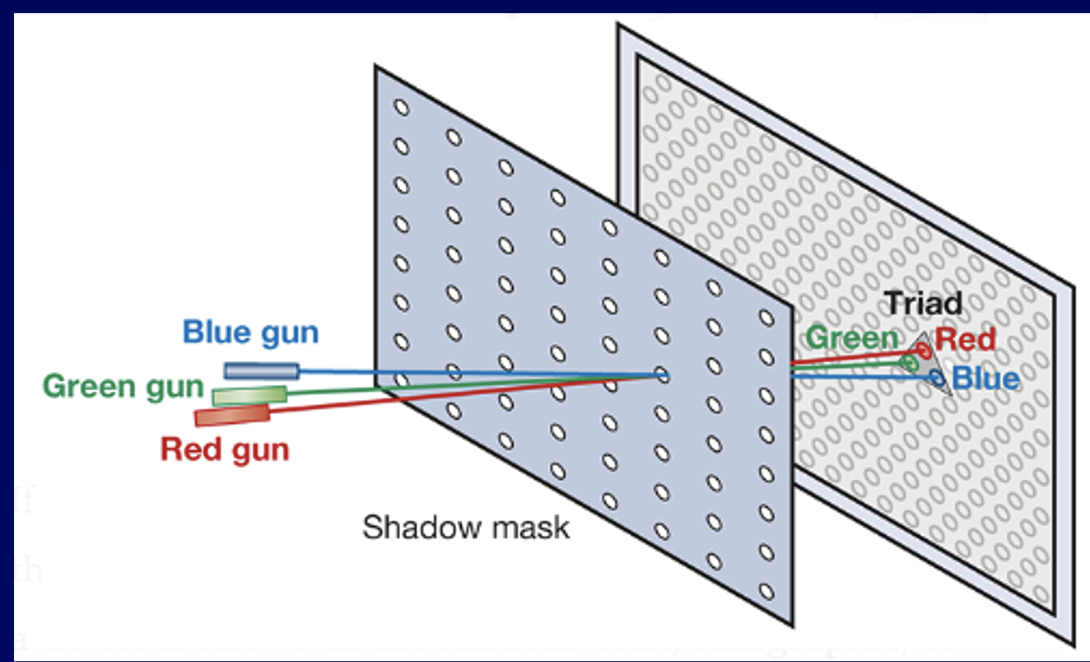
- 3 colored electron guns shoot into a raster mask that creates pixels as triads
- guns scan line by line of “pixels” so frame buffer holds the LxWxD, here it is 3 bit color
- refreshing is done at least 30 hz and line by line, so it can produce rasterized images, BUT now has aliasing due to atomic pixel size
- interlaced displays (most commercial) - signals sent to so that each refresh does every odd/even lines then interlace between every 2 refreshes
- single vs double buffering
- $n\times m$ pixel resolution
- $r$ Hz refresh rate
- $b$ bits/pixel (all colors so RGB is 3 bytes=24 bits per pixel)
- Memory space per second: \(= \frac{n\cdot m\cdot r\cdot b}8\space \text{bytes}\)
- Non-interlaced Memory Read Time: \(=\frac1{n\cdot m\cdot r}\space\text{s/pixel}\)
- interlaced is \(\frac2{n\cdot m\cdot r}\space\text{s/pixel}\)
Other displays
- Flat screens
- raster displays: active matrix with transistors at grid points
- LEDs
- LCDs: polarization of liquid crystals
- OLED
- Plasma: energize gases to glow
- VR
- stereoscopic
- foveated rendering: HD where focused, low res where not
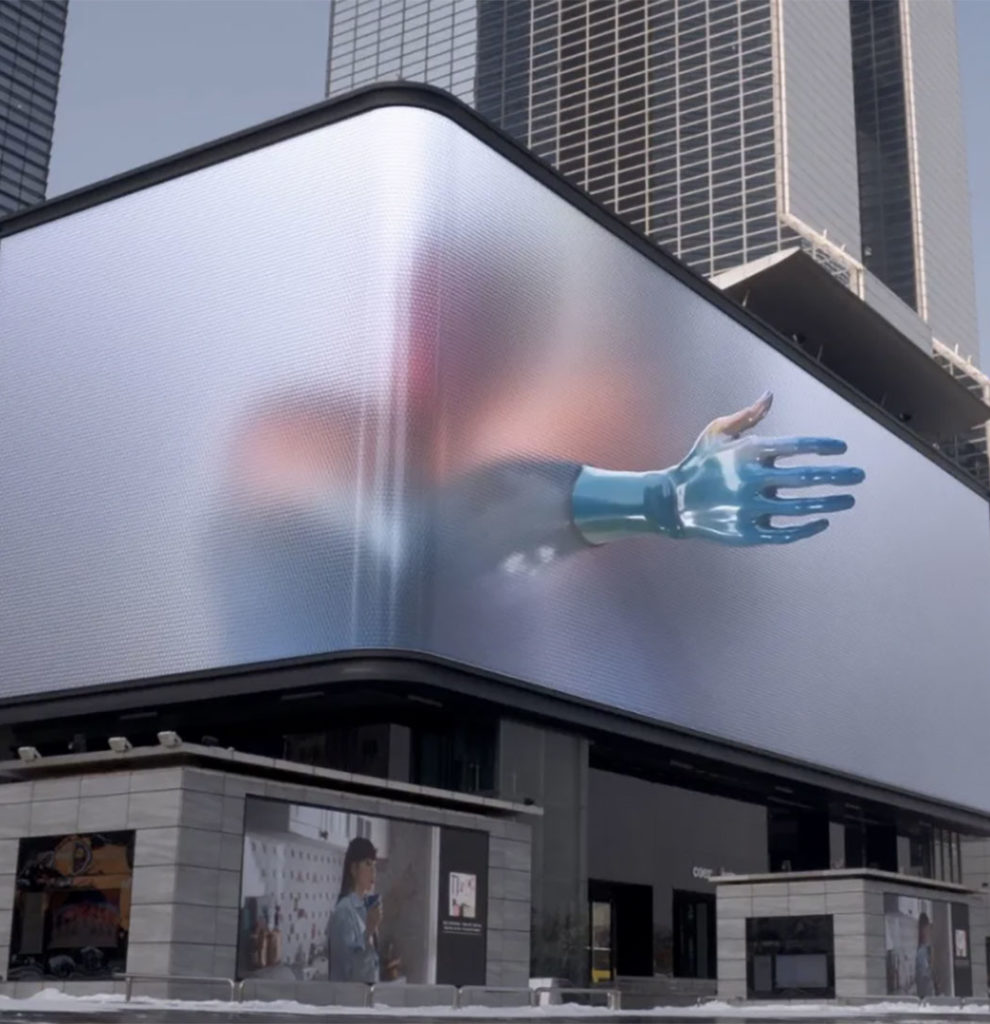
- anamorphic LED displays
- holographic real time displays
- spherical displays