4 - Camera, Projections, and Viewport
ucla | CS 174A | 2024-01-30 19:09
Table of Contents
Eye Space
- params
- eye location
- center of interest
- tilt angle or top point
- we define the camera in the World space
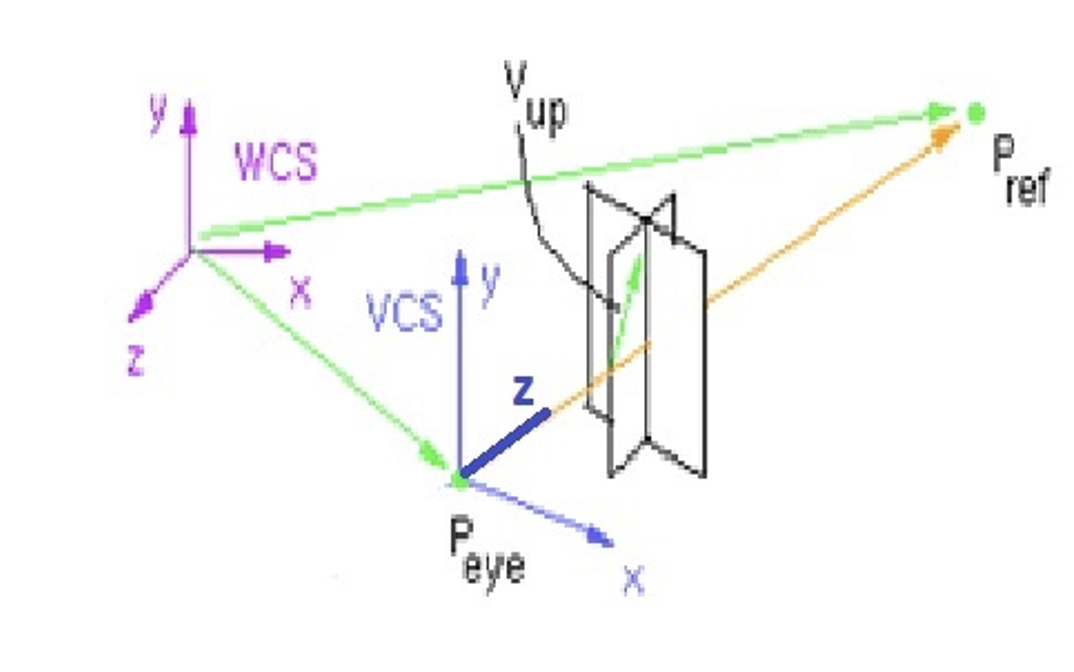
- we create bases based on the following calculations
Basis
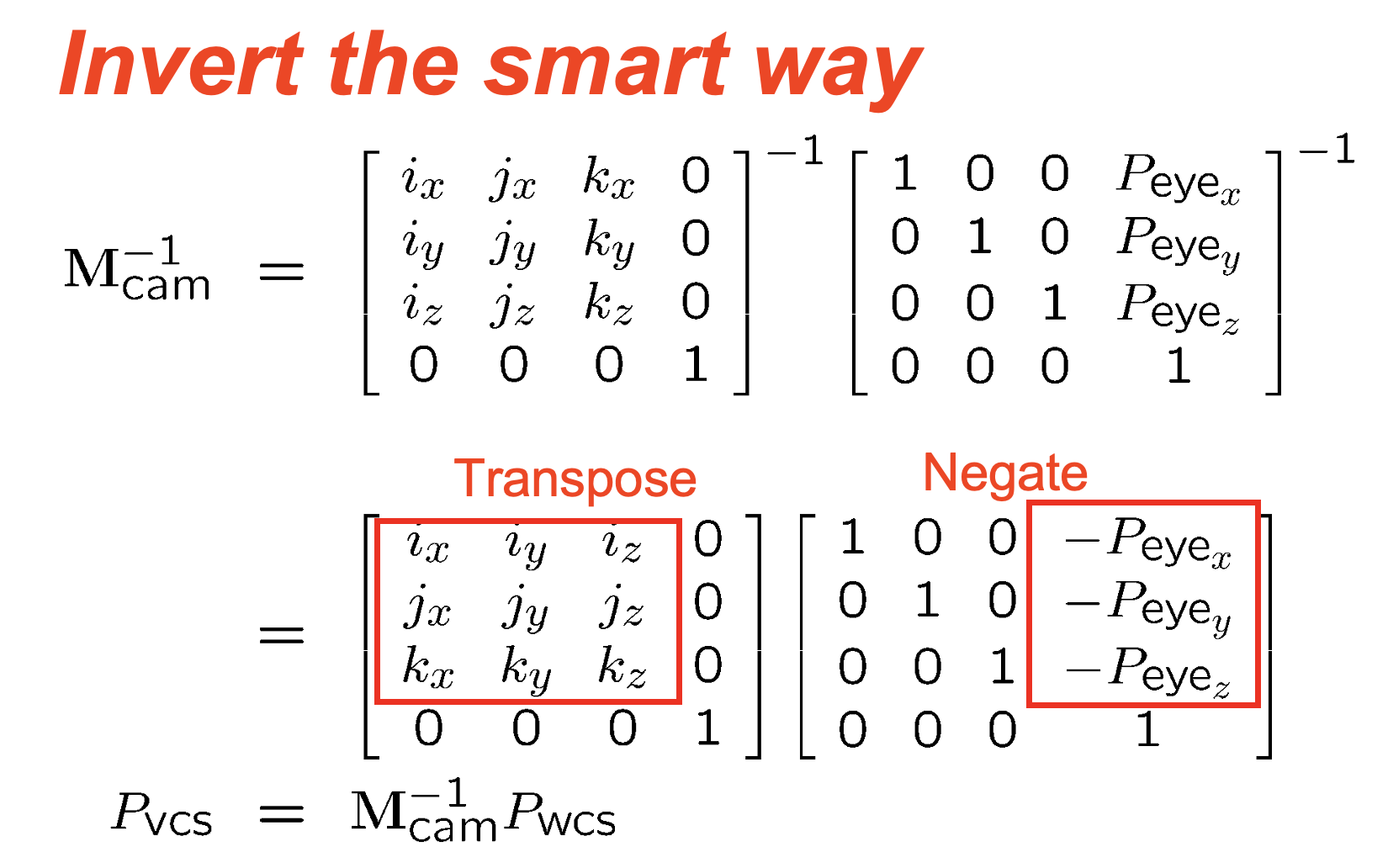
normalize to get unit vectors for basis - align as column vectors \(\vec k = P_{ref=COI}-P{eye}=\vec E\) \(\vec i= \vec v_{top=up}\times \vec k\) \(\vec j=\vec k\times\vec i\)
- however, now $\vec i$ is now positive in the LHCS, so to fix this, we mirror it i.e. negate s.t. $\vec i \leftarrow -\vec i$
- the eye basis now points $\vec k$ in line with the COI so greater magnitudes of $\vec k$ sends the object farther back away from the camera at the origin of the eye space (VCS)
Viewport Idea
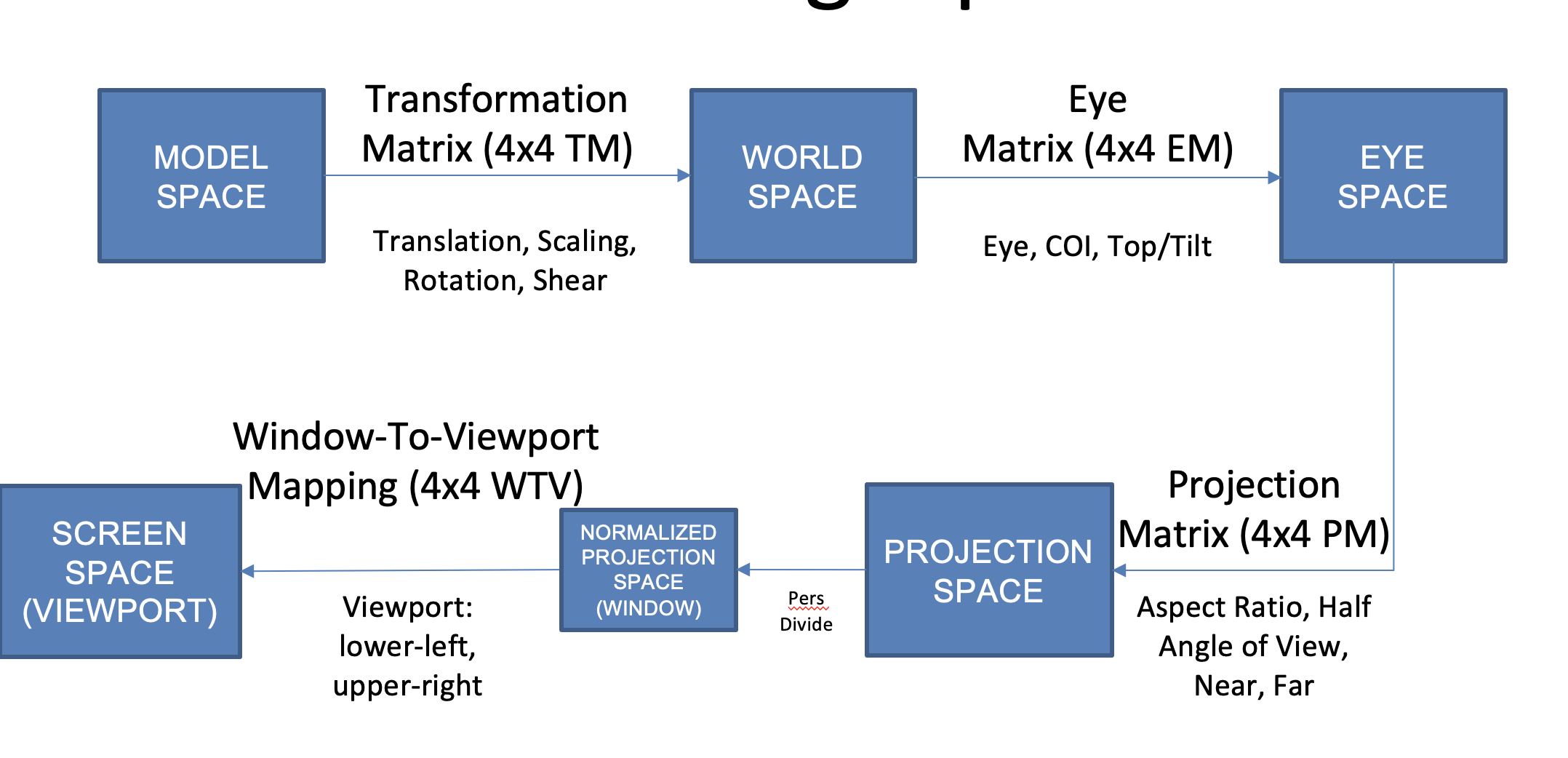
- we can take a point and project it to the viewport by applying a single amtrix that is the cross product of multiple matrices: transformation, eye, projection, etc. \(\text{True Position}=[PM][EM][TM]P\)
- then send that to the viewport; each matrix is 4x4 and the point is 4x1
Projections
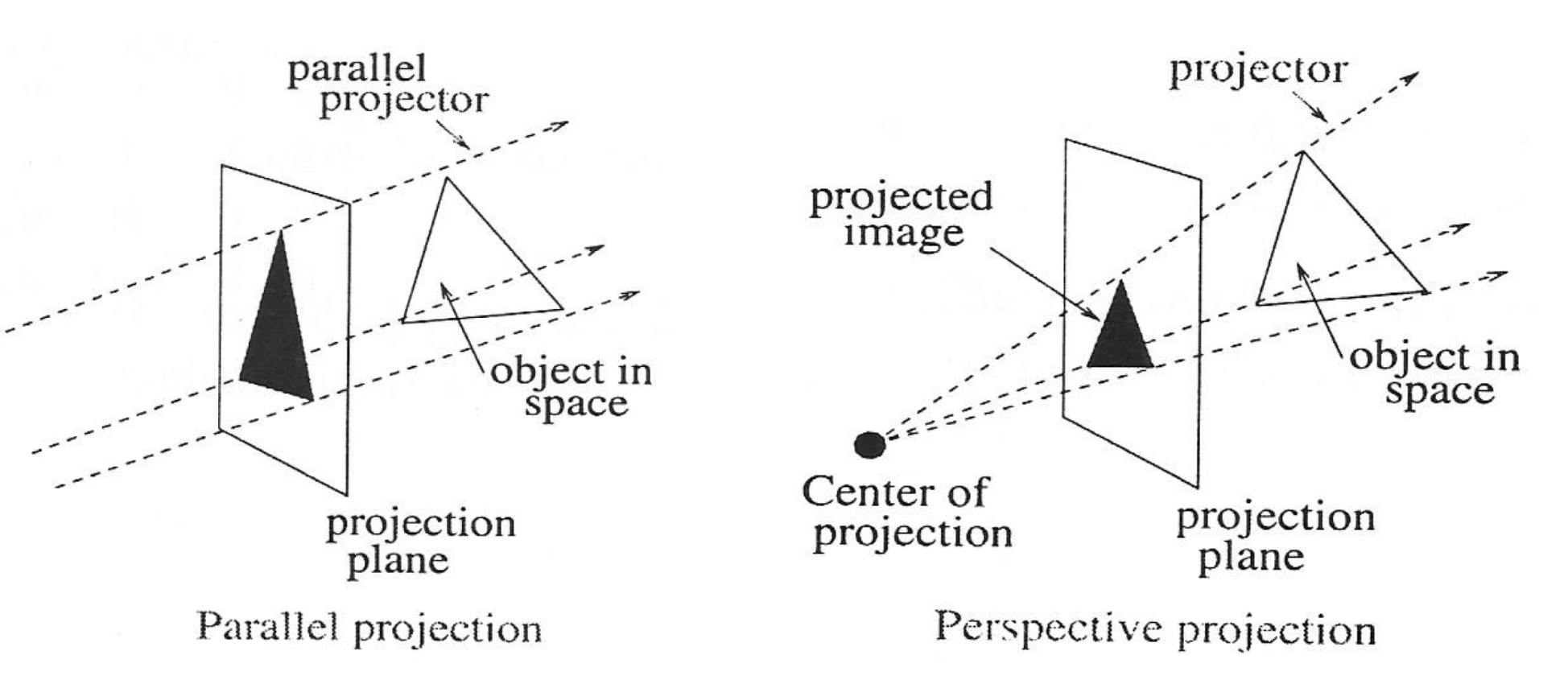
- orthographic projections
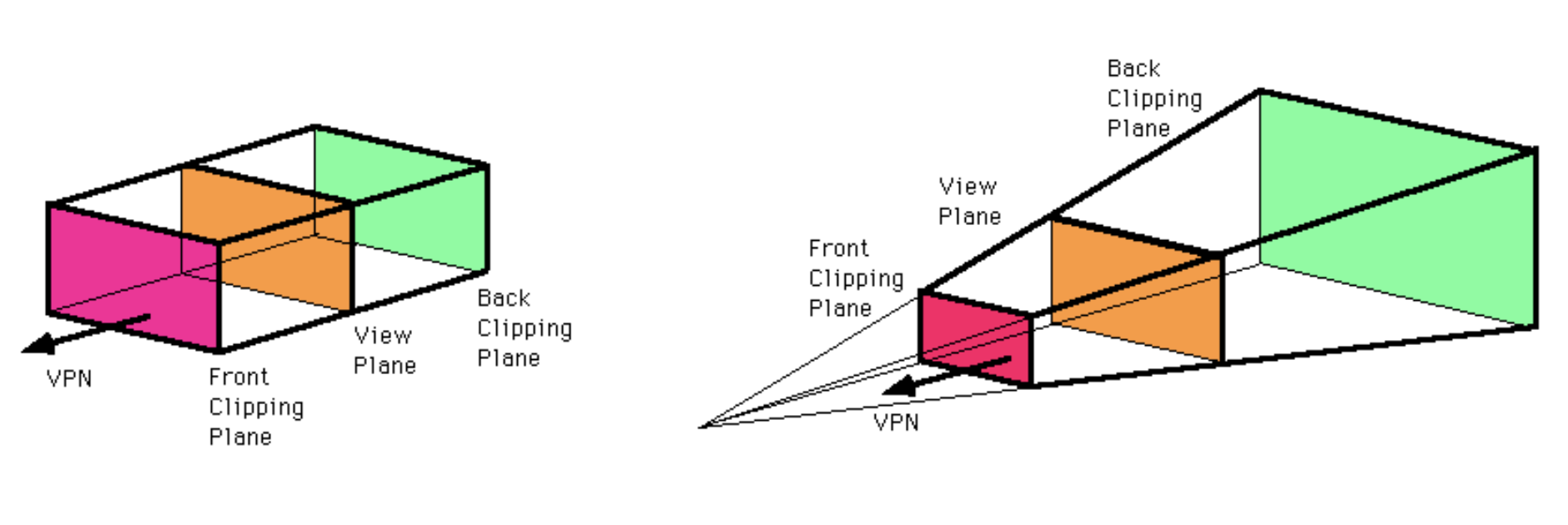
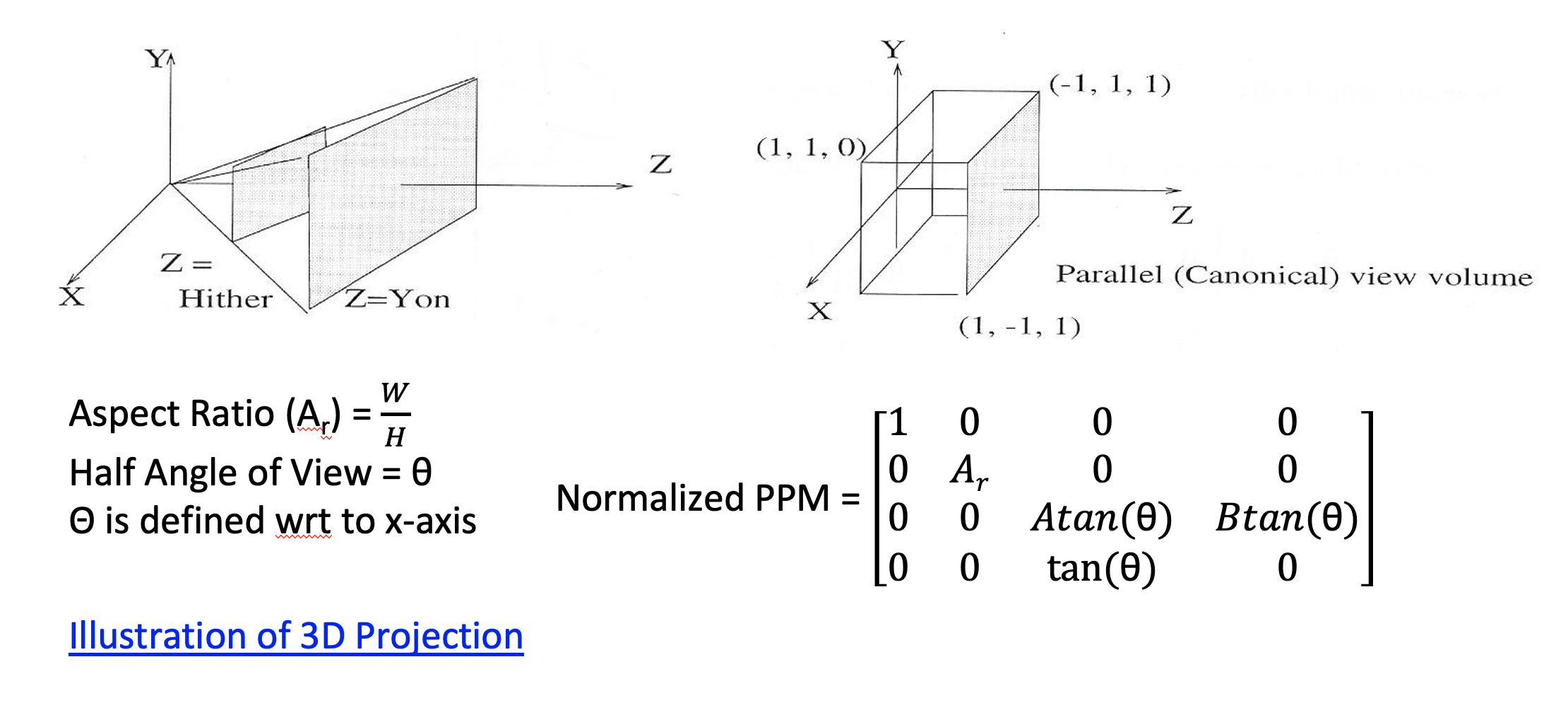
- the canonical view volume is the unit parallel projection with \(x\in(-1,1),\space y\in(-1,1),\space z\in(0,1)\)
- given a volume the view volume dimension are -W to W width, -H to H and distance D=far point - near point
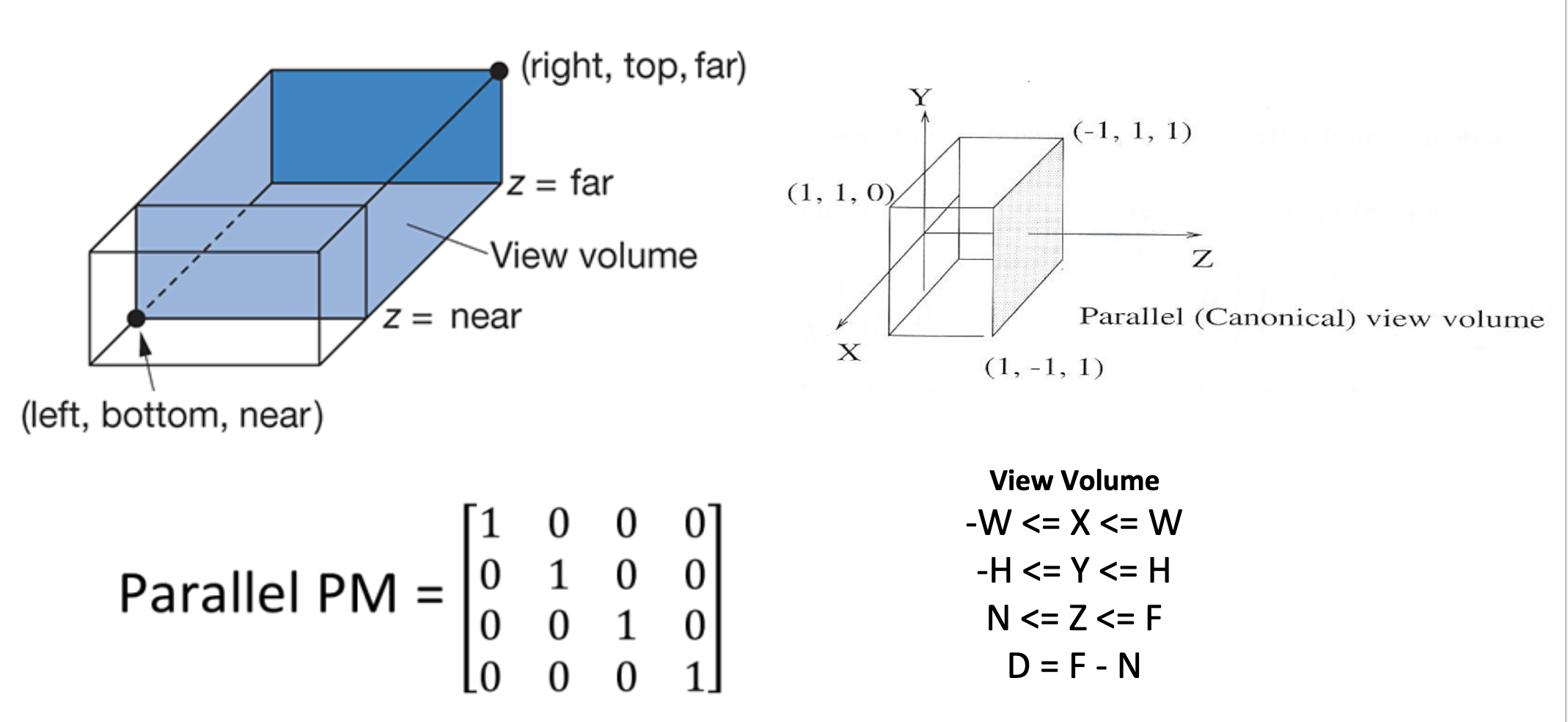
- the parallel projection matrix is the identity
Perspective Projection
- NOTE: slides are different
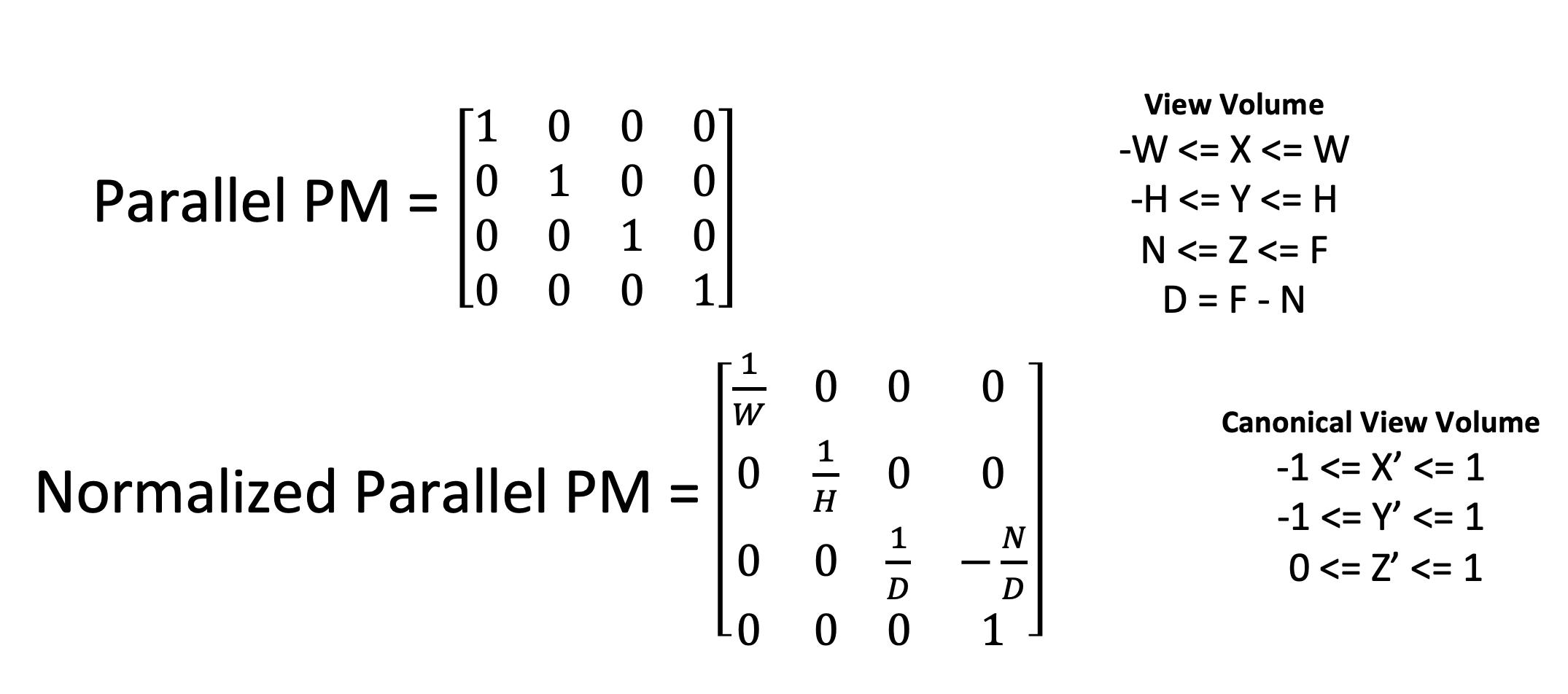
- square projection viewport
- the half angle is angle wrt to x-axis from the z/k axis to the edge of the view volume to one side, the area swept by $(-\theta,\theta)$ is the width of the view volume
Normalization
- the projection plane: $(x’,d)$ is the near plane that is a distance $d$ away from the eye space origin
- the object (a point: $(x,y)$) is placed on the far plane at a distance $F=x$, then the projected x value on the projection plane is \(\frac{x'}d=\frac xz\quad s.t.\quad x'=\frac{x}{z}\cdot\frac d W = \frac{x}{z\tan\theta}\)
- here $W$ is the range of x-values swept by the half angle on the projection plane
- similarly for the y-axis, where H is like W \(y'=\frac{y}{z}\cdot \frac dH=\frac{y}{z}\cdot \frac dH\cdot\frac WH=\frac{yA_r}{z\tan\theta}\)
- however for z-axis everything collapses to the projection plane so it is a constant \(z'=\frac1{\tan\theta}\)
- the division of $z\tan\theta$ is known as perspective division and scales the x,y based on distance -> making farther smaller and closer bigger
- final matrix is all of these plus the 1 at the last 4th dim
- but we lose depth which we need for hidden surface removal, so we can define a new matrix with some linear function for $z’$
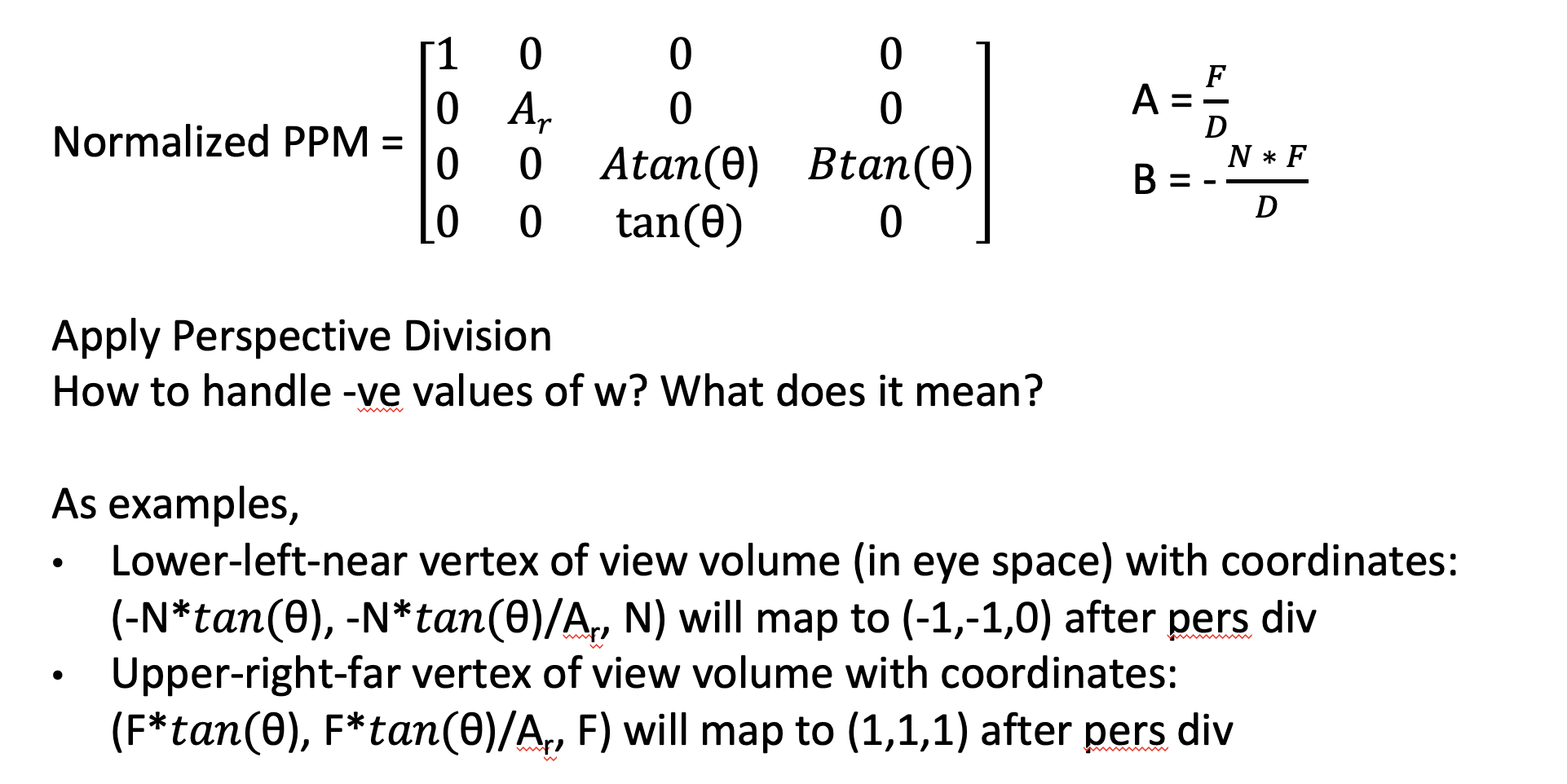
- so we create a perspective projection matrix that maps the perspective objects into a parallel NDC (openGL) cube which we can render to the viewport; here N is near value, F is far value, D is depth:
Window to Viewport Mapping
- where T is transformation and S is scaling
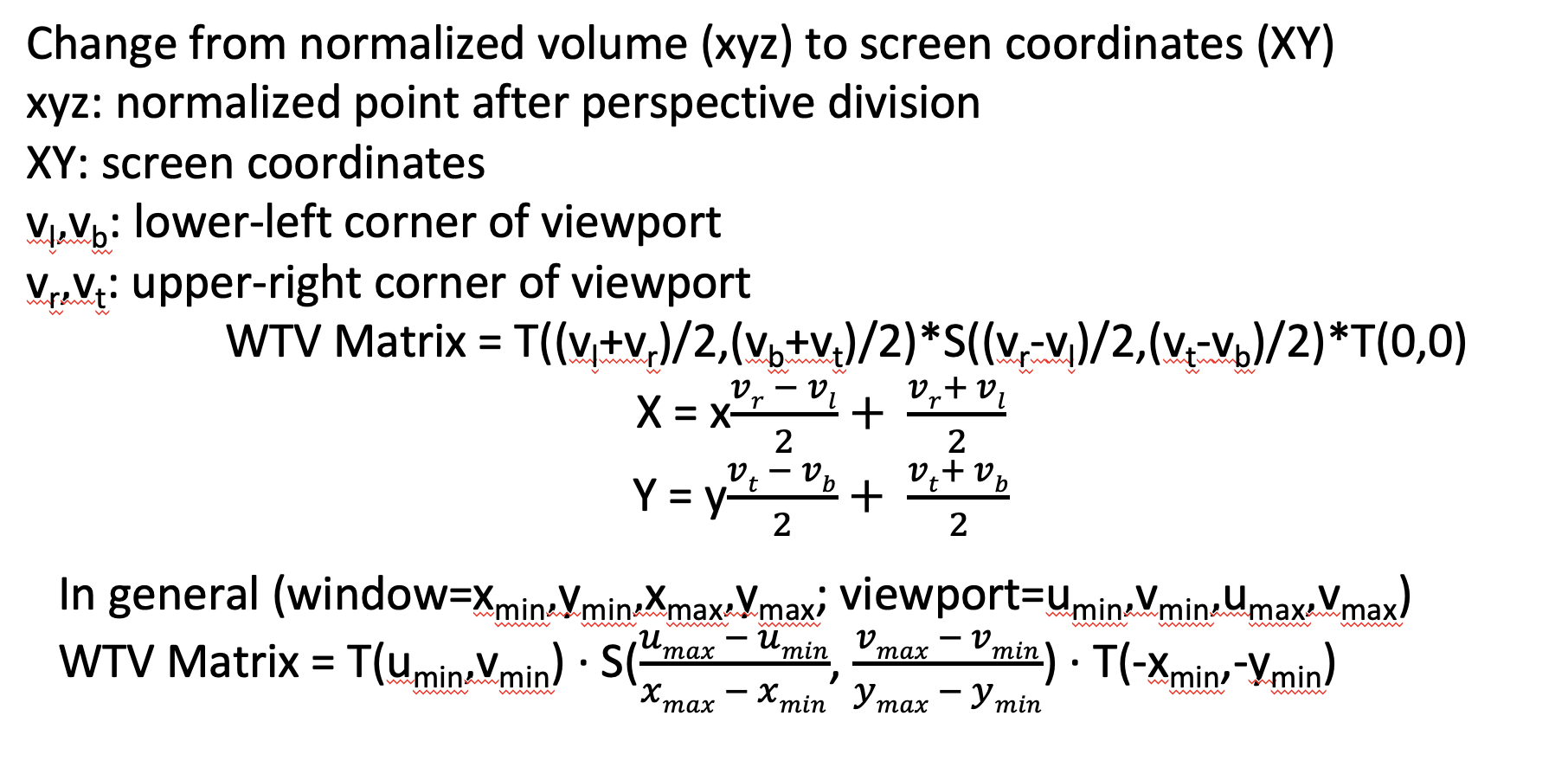
- \(WTV=T(\frac{v_l+v_r}2,\frac{v_b+v_t}2)\cdot S(\frac W2,\frac H2)\cdot T(0,0)\)
Final Rendering Pipeline