08 - Software Testing
ucla | CS 130 | 2024-11-25
Table of Contents
Software Testing
- to detect diffs bw observed and expected (errors due to omission or commission)
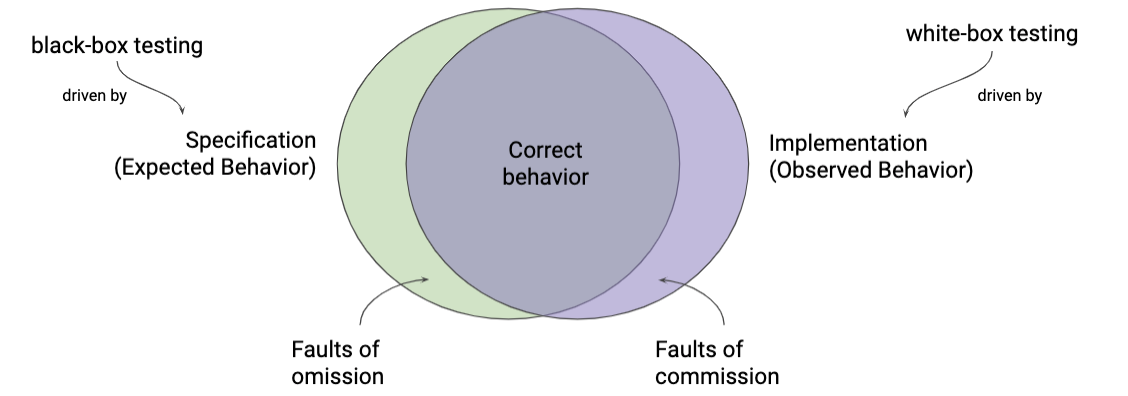
- test-driven dev suggests writing testable code via:
- Unit testing (devs) tests indiv modules
- Regression testing: (devs or testers) incremental differential tests of previously tested sw after change
- Integration testing (testers) interface bw multiple sw modules
- System testing (testers) end-to-end testing
- Acceptance testing (users) tests user requirements on a release candidate of the system
Isolating Item-Under-Test (IUT)
- to reduce uncertainty, isolate - e.g., mock/patch
- Test stub: mock items called by IUT
- Test driver: mock items that call IUT
JUnit - Test Automation
- testing is hard bc failure causes may be sparse
- e.g.,
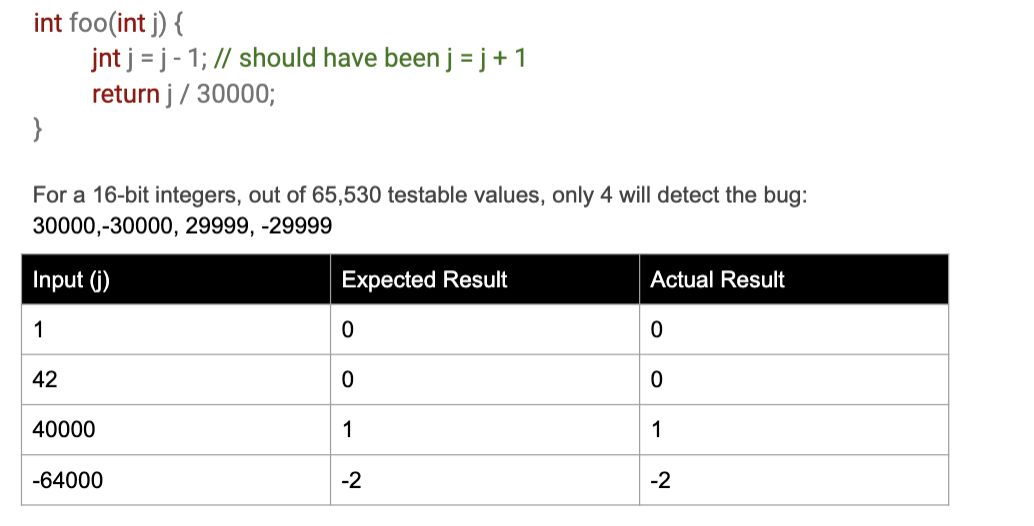
- e.g.,
- so automate via frameworks - e.g., JUnit for Java testing
Features
- Annotations, assert statement, test fixtures for common shared code/data, test aggregation for suites
- Annotation Examples
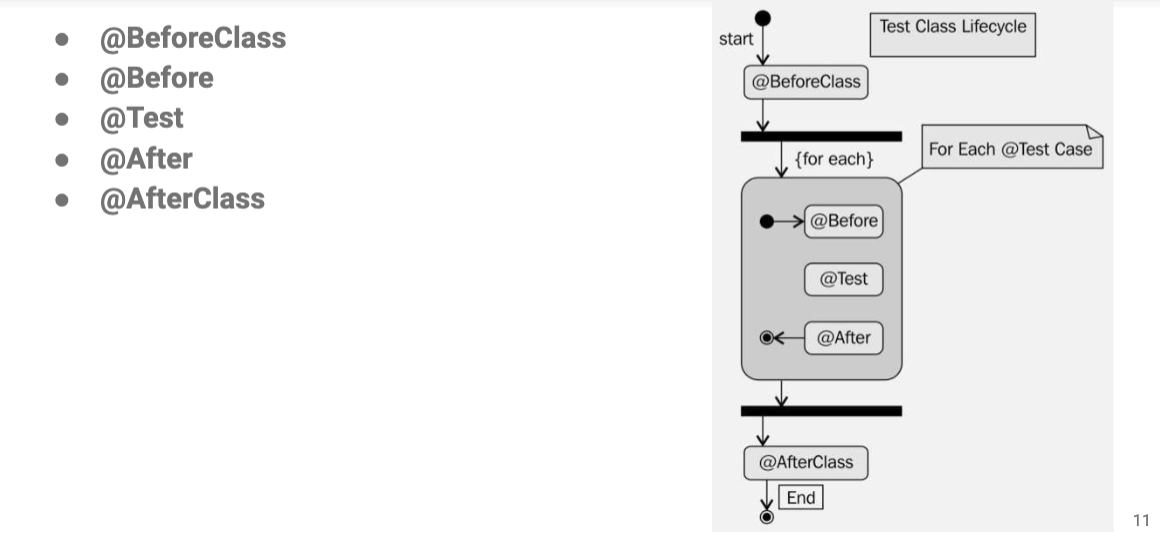
- code example
  public class DummyTest {
  private static List<String> list;

  @BeforeClass
  public static void beforeClass() {
      list = new ArrayList<String>();
  }

  @Before
  public void before() {
      list.add("Alex");
  }

  @Test
  public void getElement() {
      String element = list.get(0);
      assertEquals(element, "Alex");
  }

  @After
  public void after() {
      list.remove("Alex");
  }

  @AfterClass
  public static void afterClass() {
      list = null;
  }
  }
- code example
- Assertions
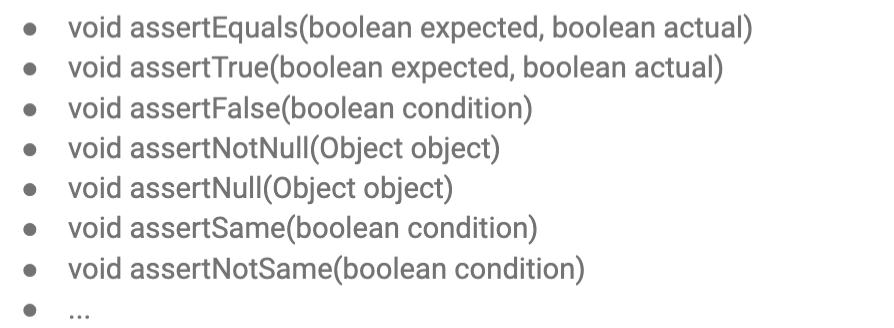
- code example
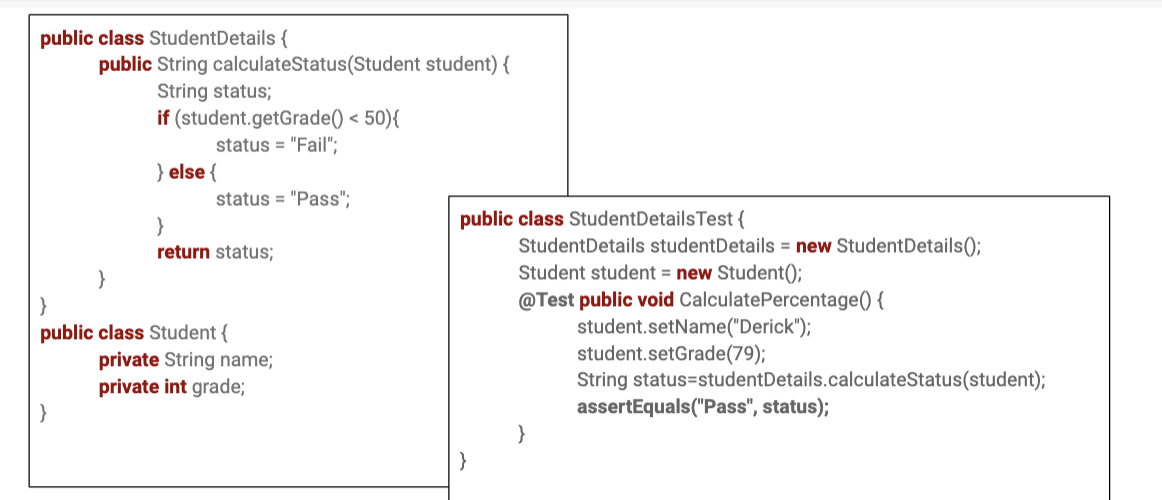
- code example
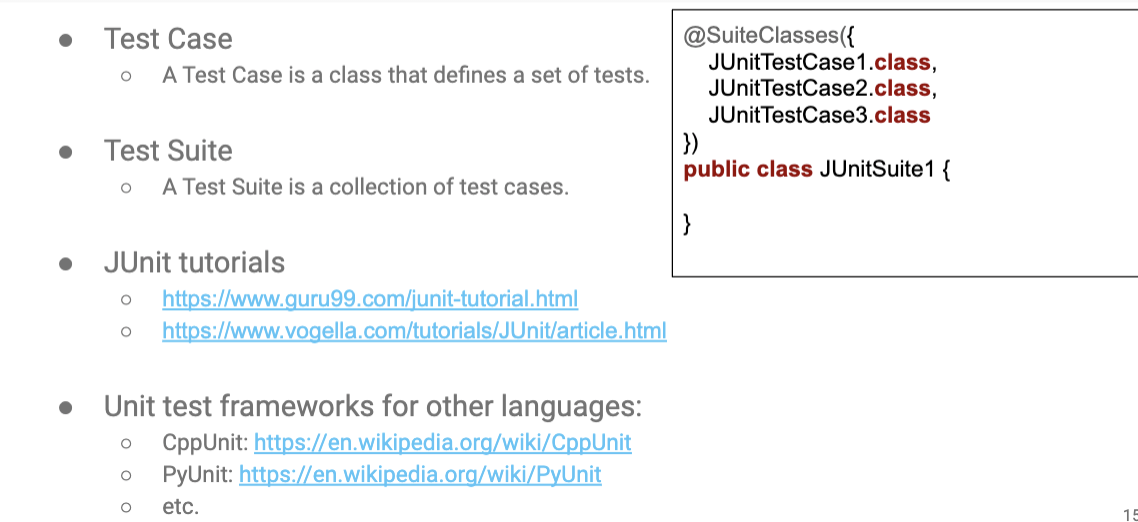
- other features
Control Flow Testing
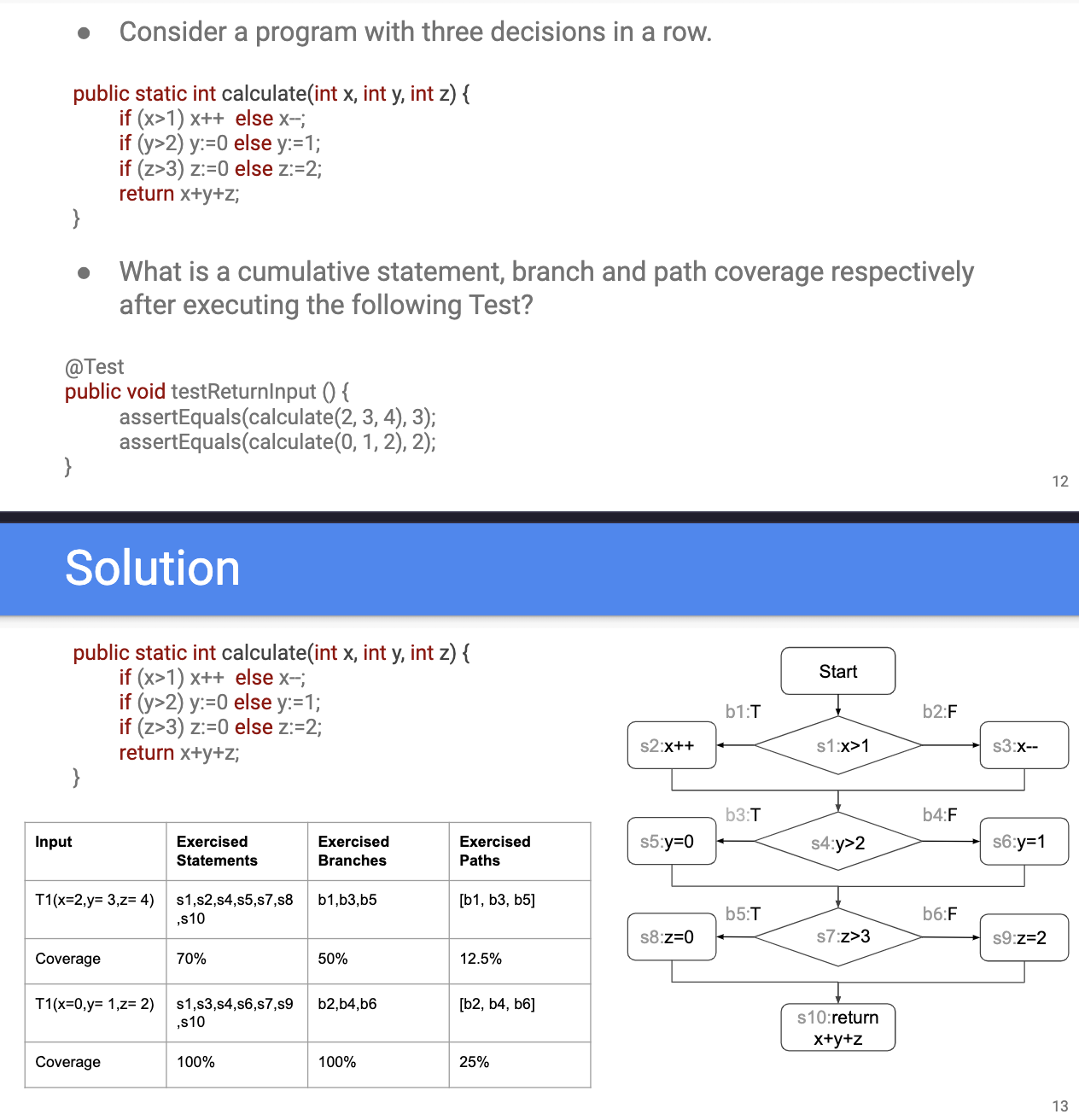
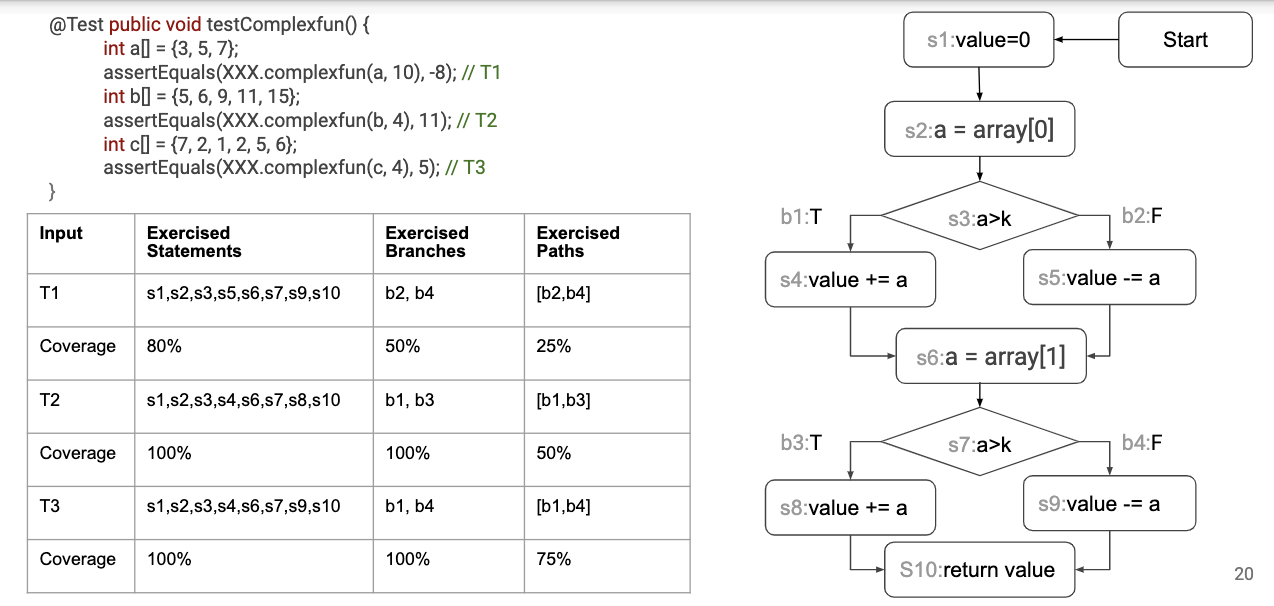
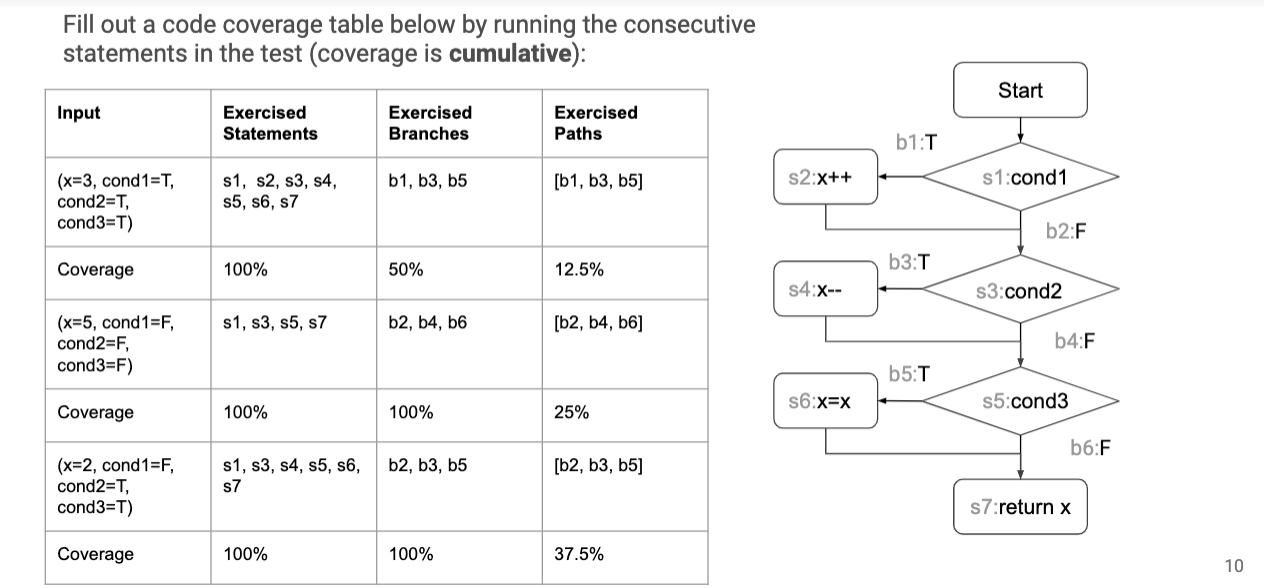
- statement coverage - percent of statements executed by tests
- branch coverage - % of branches explored by tests
- path coverage - % of control flow paths explored by tests
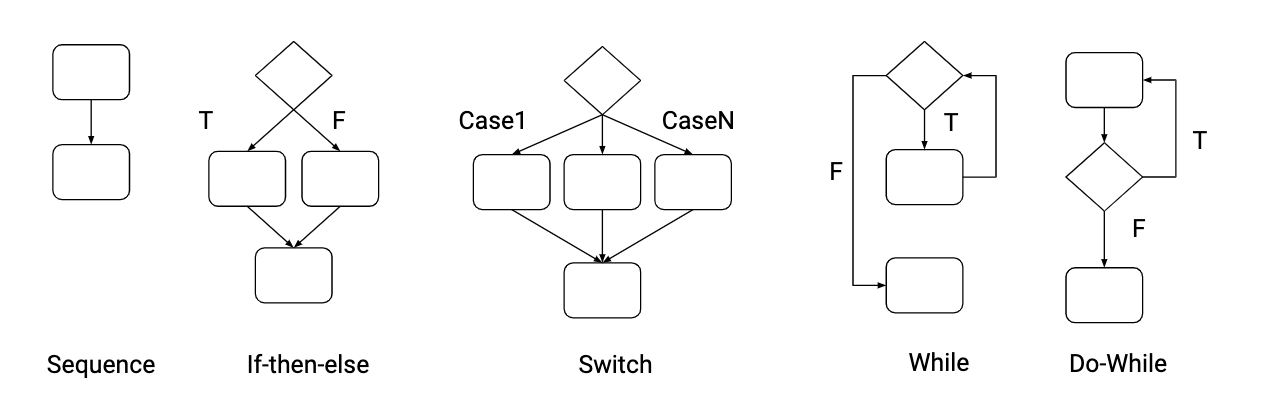
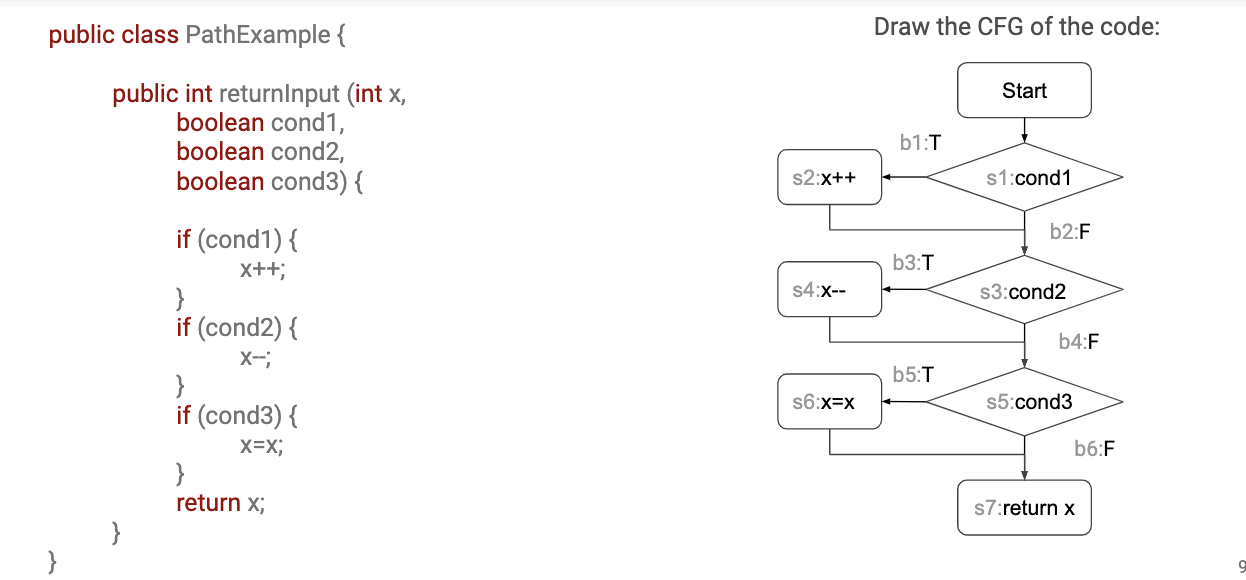
- Control Flow Graph (CFG) Notation
Analyzing Test Coverage
- given
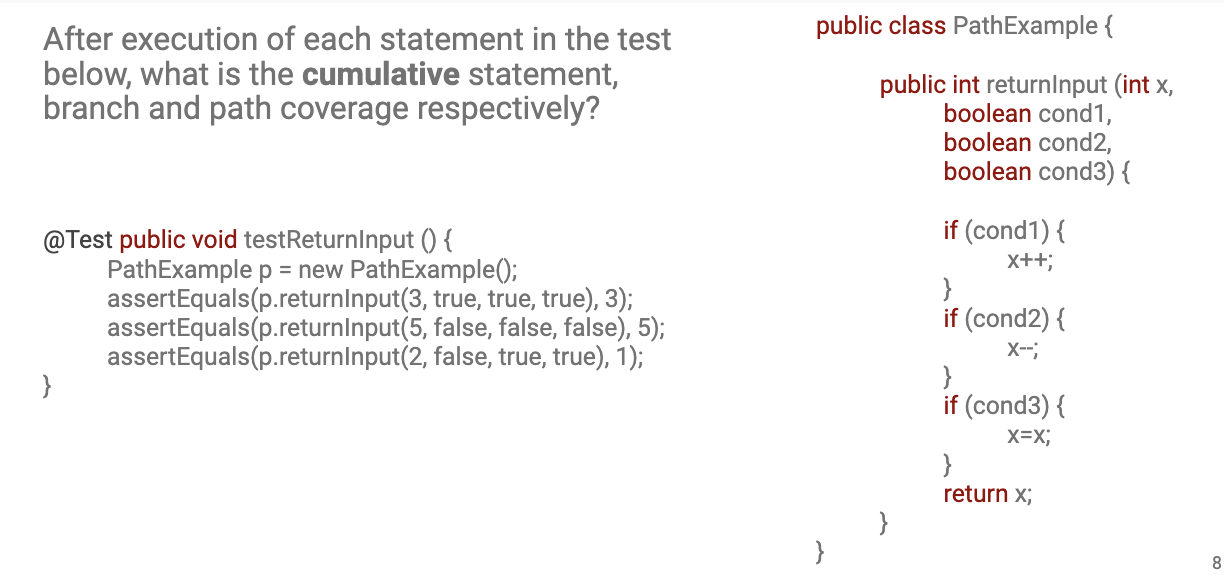
- solution:
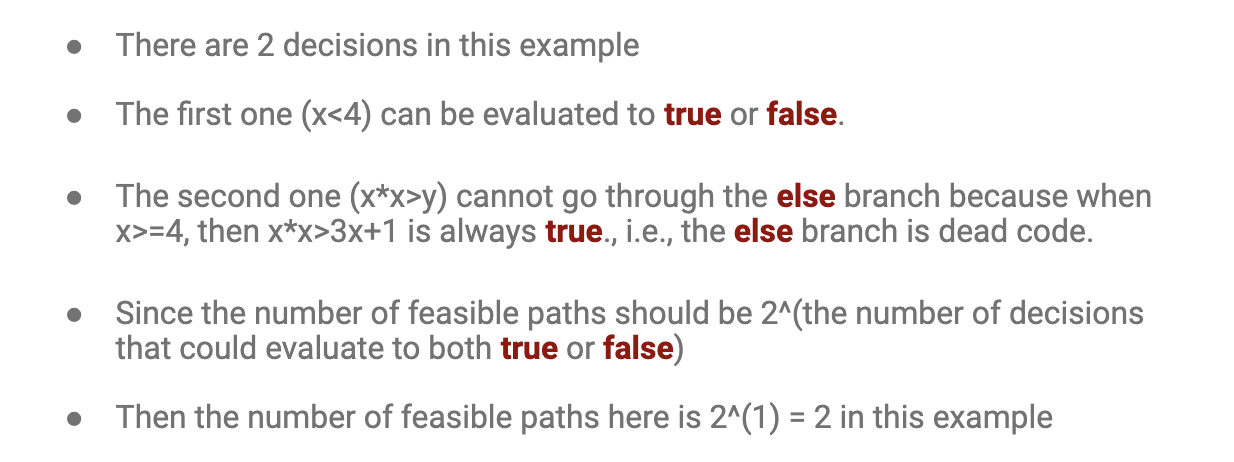
- measured via decision takes T or F branch
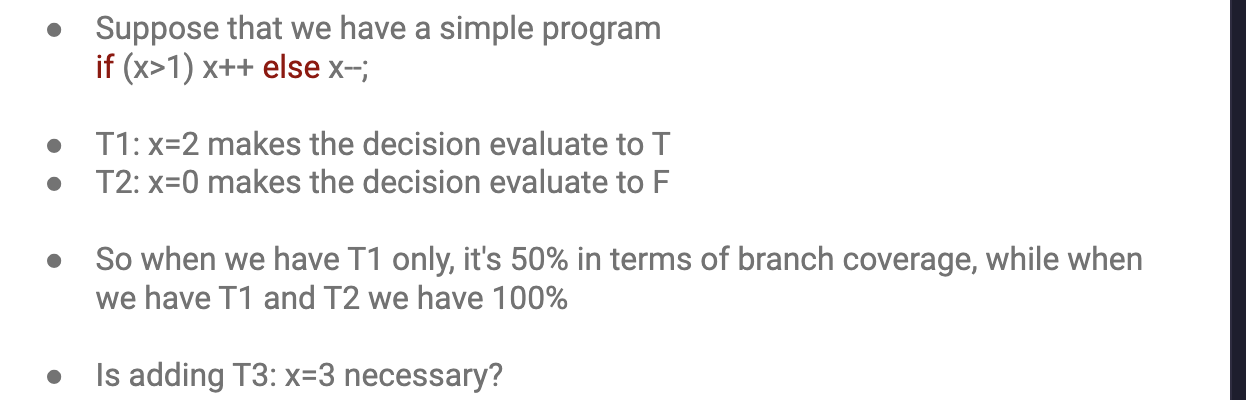
- example
Path Count Estimation
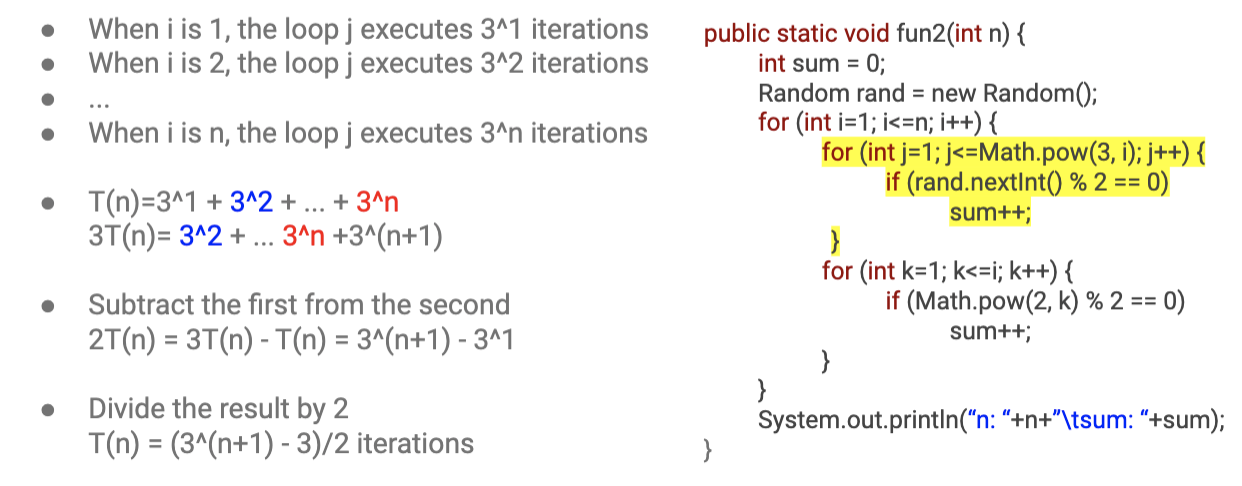
- entails estimating number of loop iterations for bounded progs
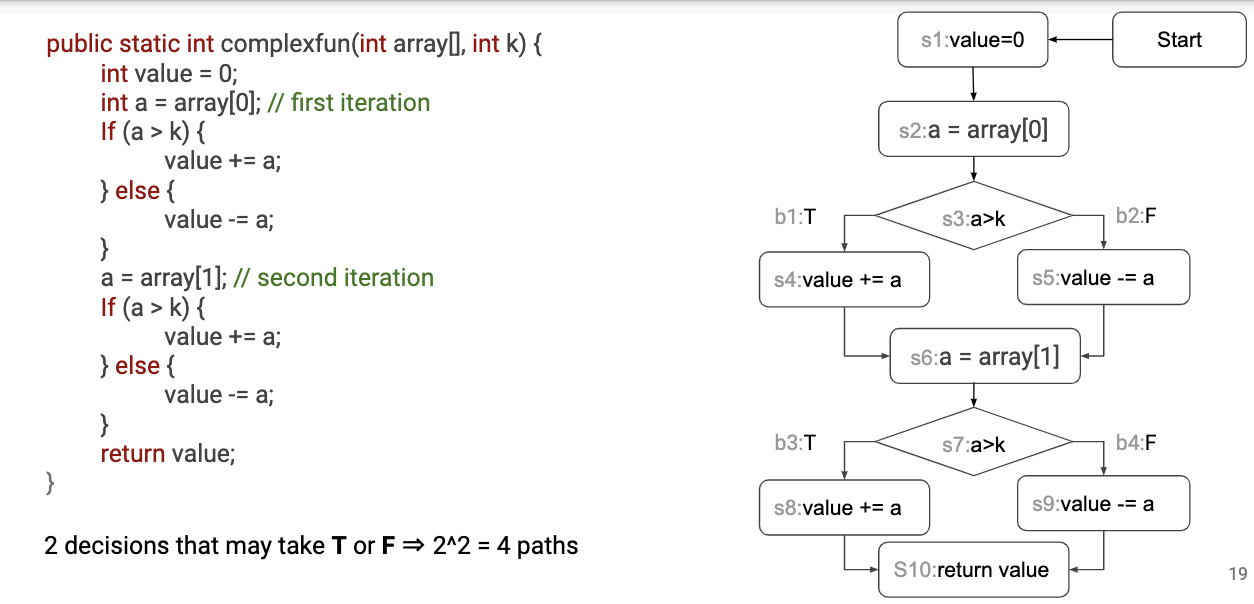
- for loop free with $k$ decisions => $2^k$ feasible paths
- for loops -> perform loop unrolling s.t. number of paths = $2^\text{# of non-det. decisions}$
- e.g., given
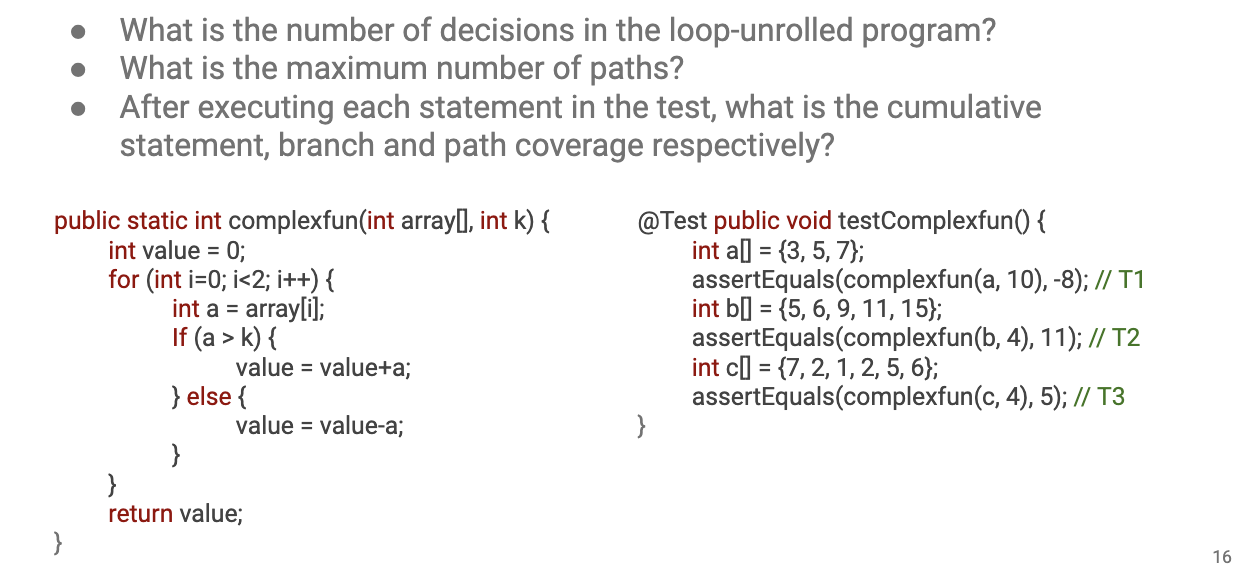 we can follow the steps of CFG then loop unrolling:
- draw CFG
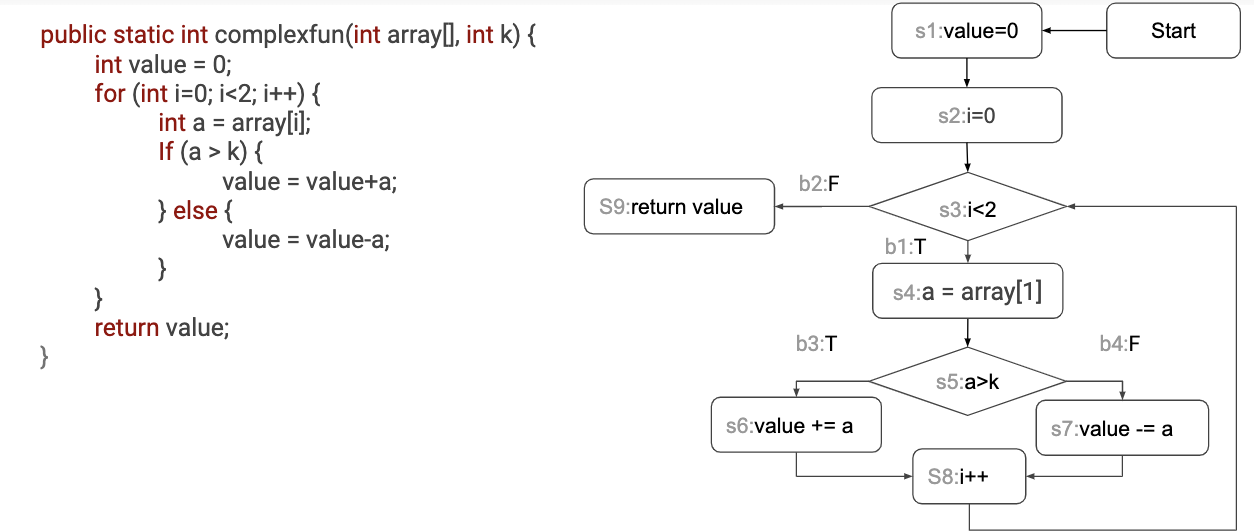
- unroll loop
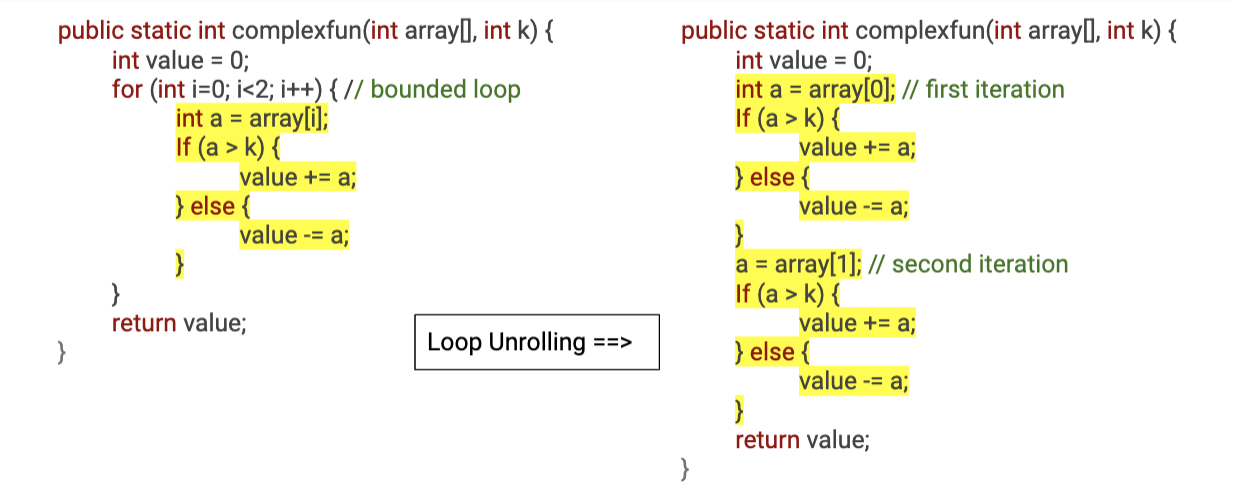
- draw unrolled CFG
- calc coverage table
- draw CFG
- nested loop estimation via polynomial combination
Symbolic Execution
- path counts evaluate whether branch flattens to true or false in nondeterministic paths
- unconditional code is deterministic
- but, infeasible paths are dead or unreachable code
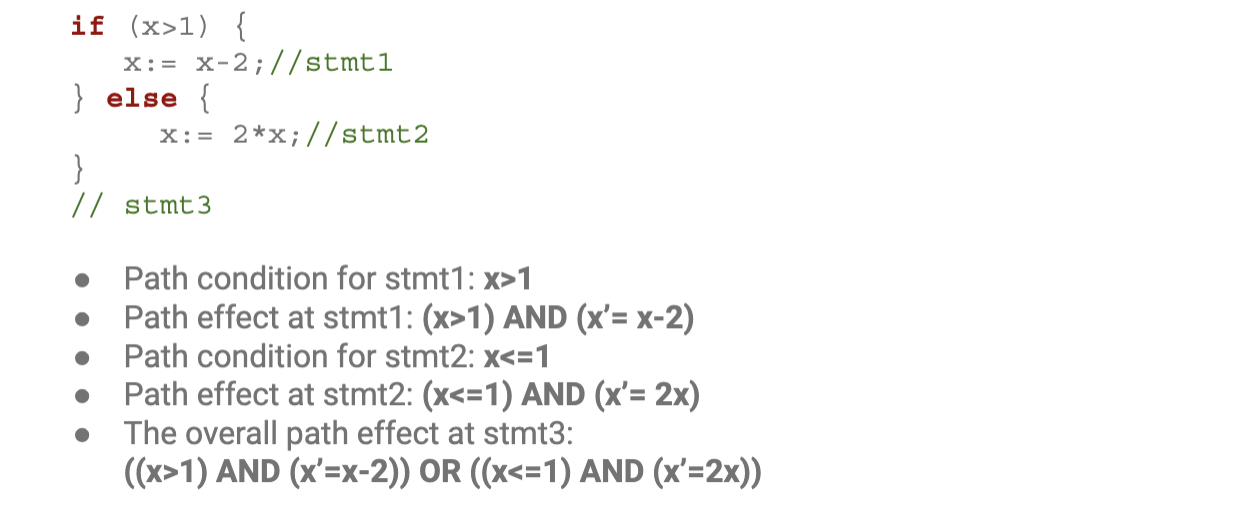
- symbolic execution - unroll loop -> use fresh vars in beginning and with state updates -> for each decision propagate both branches: for each path, the condition exercised is the path condition and the result is the path effect e.g.,
- examples
- given1
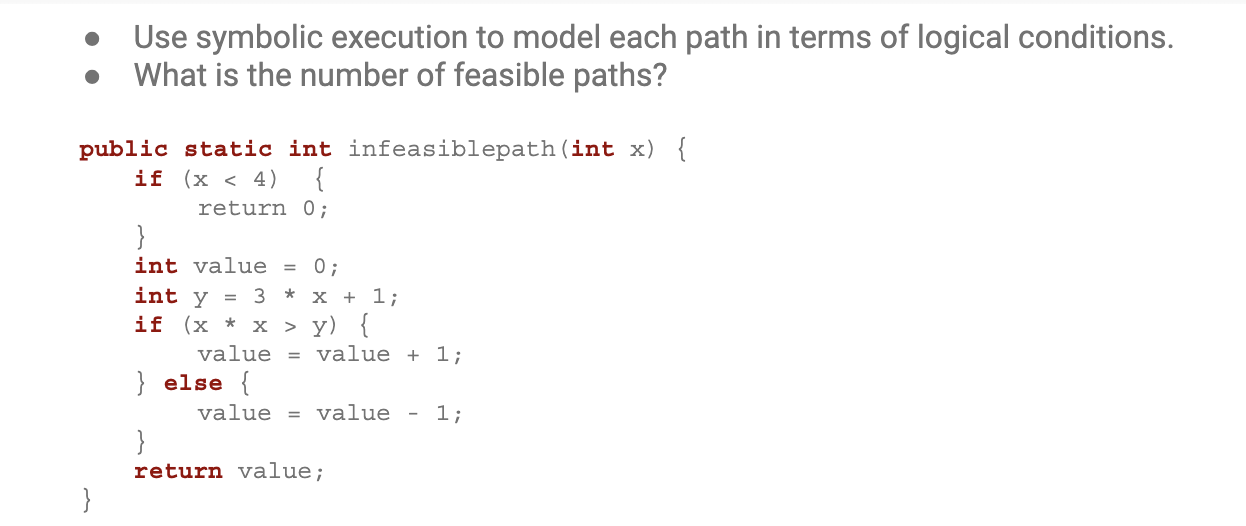
- solution1
- example 2
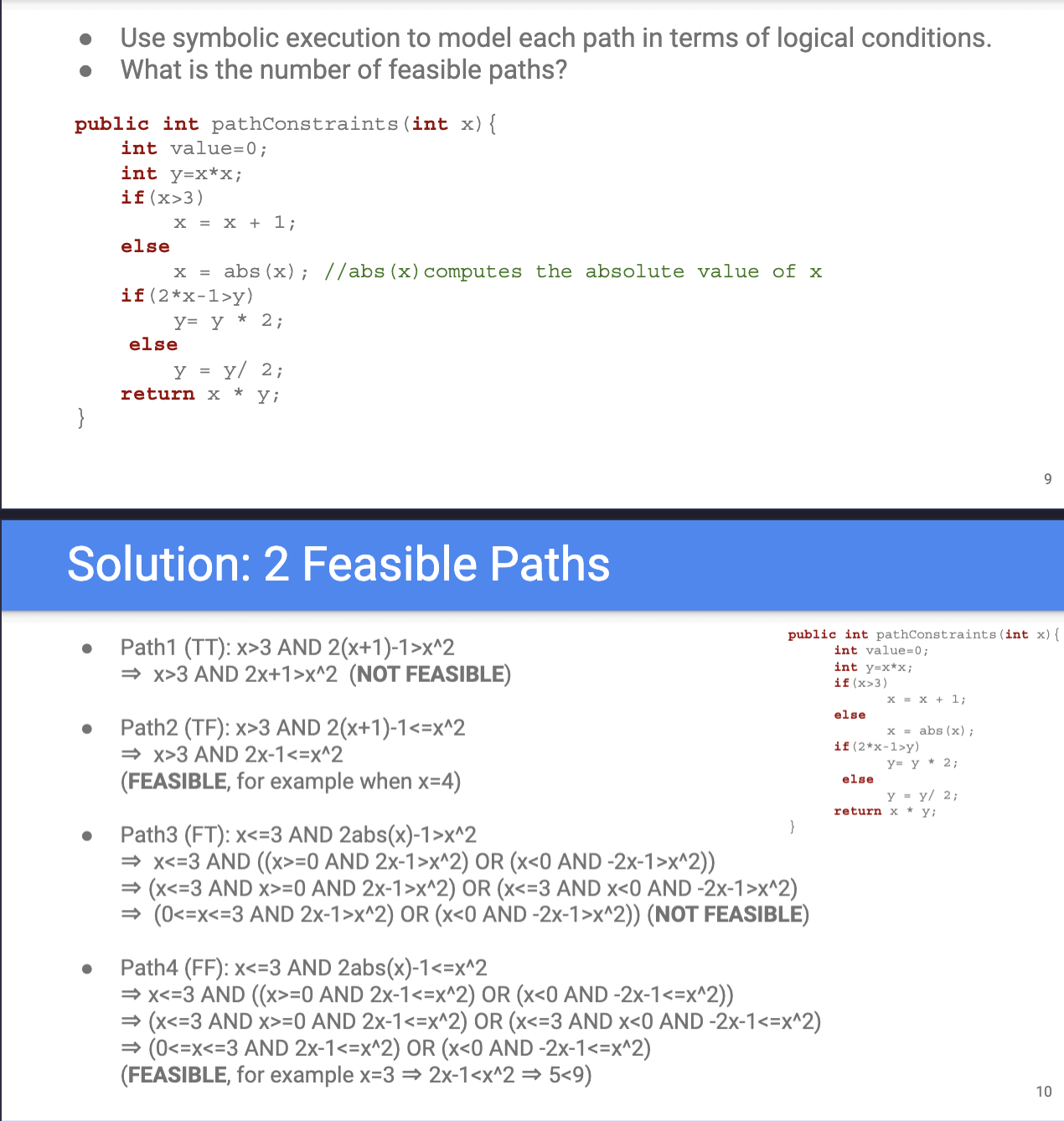
- given1
Generating Test Input
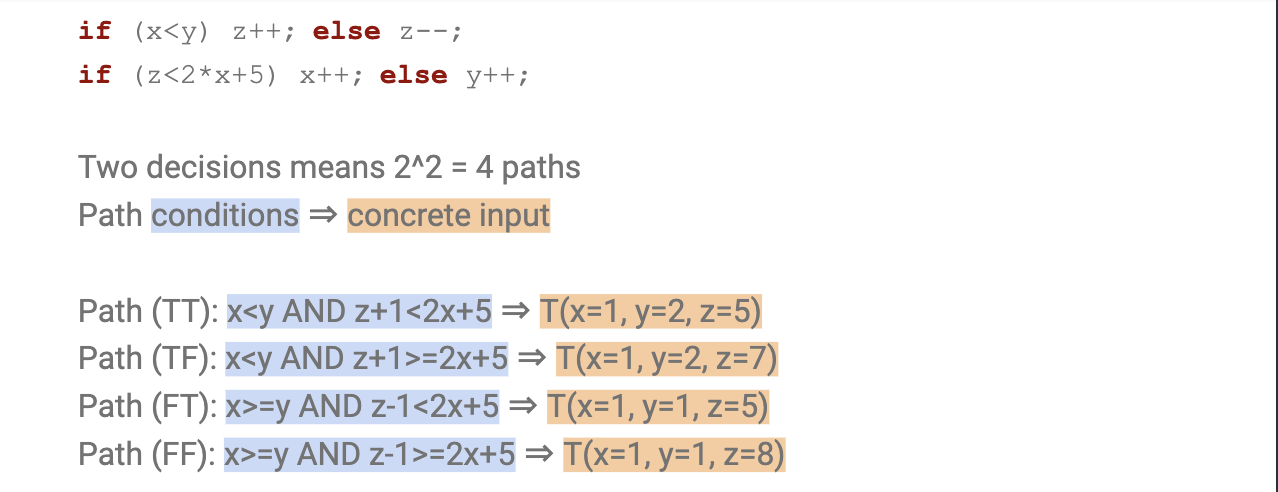
- symbolic execution can generate test inputs - determine path conditions then find concrete input values that make the path condition true
Regression Testing
- testing to ensure incremental changes don’t take a step “backward” and cause failures of previously succeeded test cases
- goal is to select a set of minimum tests to ensure no regressive changes
Regression Test Selection (RTS)
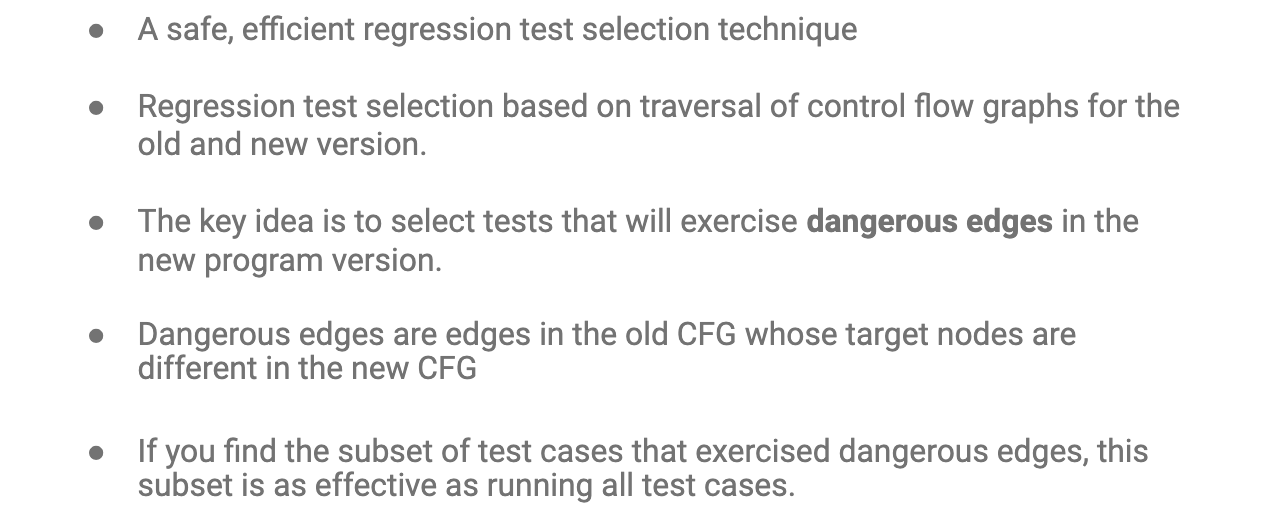
- idea is given older version of prog $P$, create test suite for $P$ called $T$ and use it to generate coverage matrix $C_{PT}$-> create new version $P’$ and calc delta bw new and old version -> use to select $\subset T$ s.t. safe RTS covers new version
- e.g., Harrold & Rothermel’s RTS
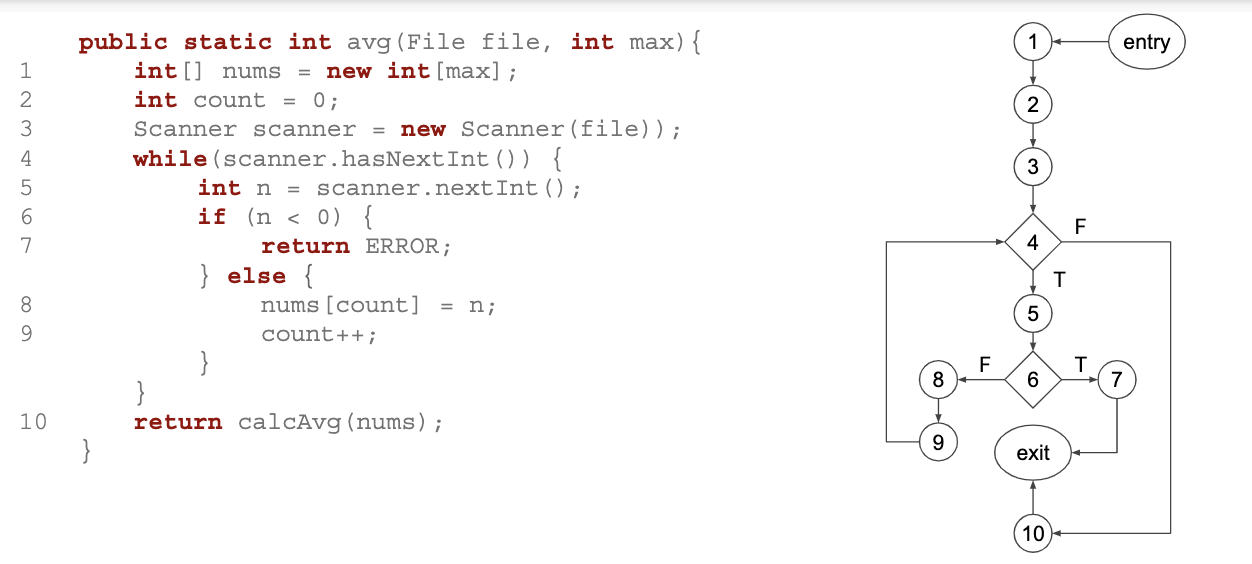
- Build CFG of original prog $P$
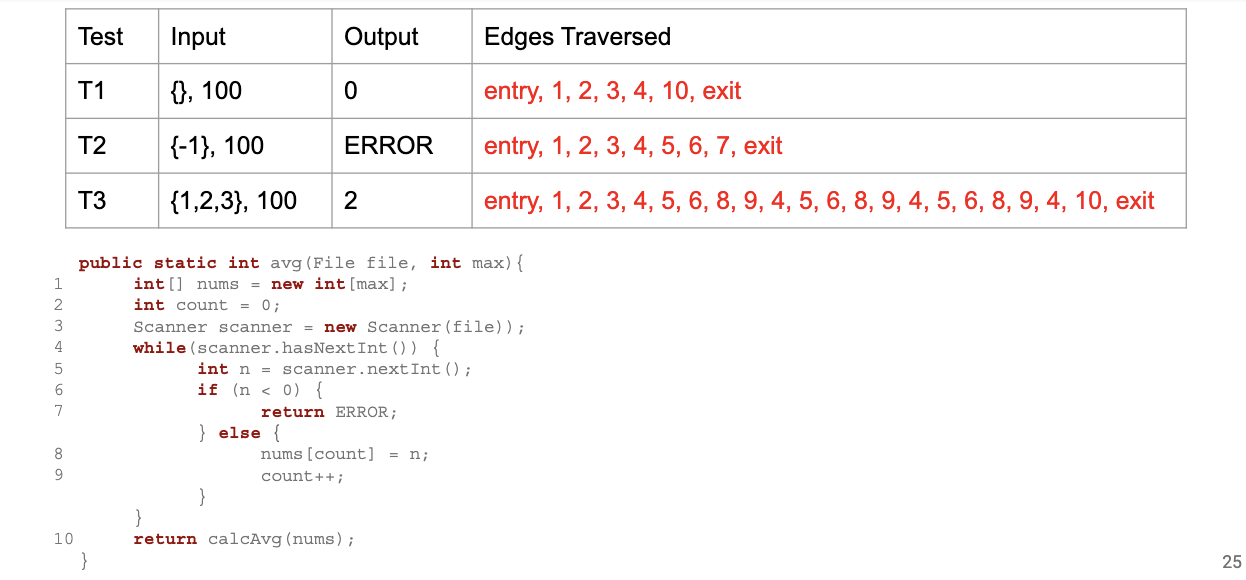
- run test suite $T$ on $P$
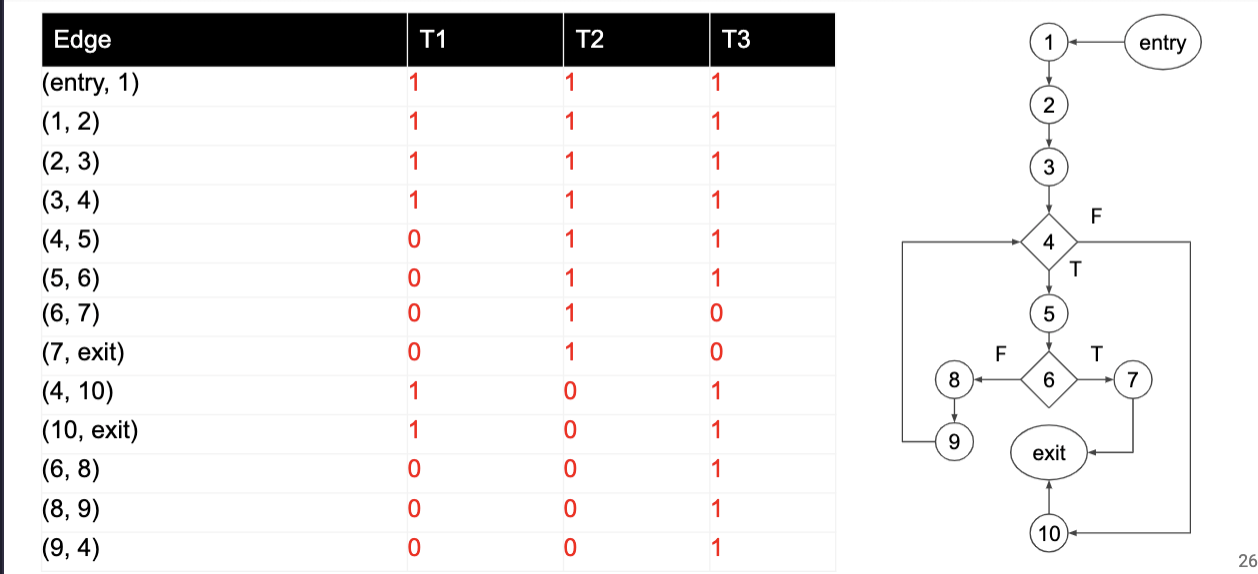
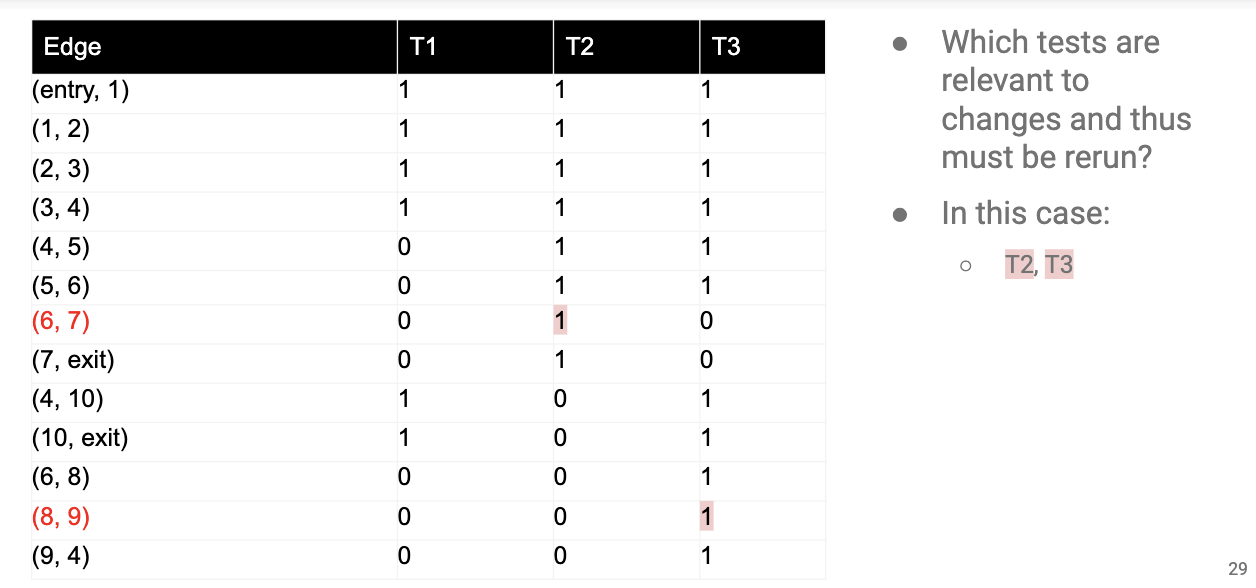
- build coverage matrix $C$
- build CFG of $P’$
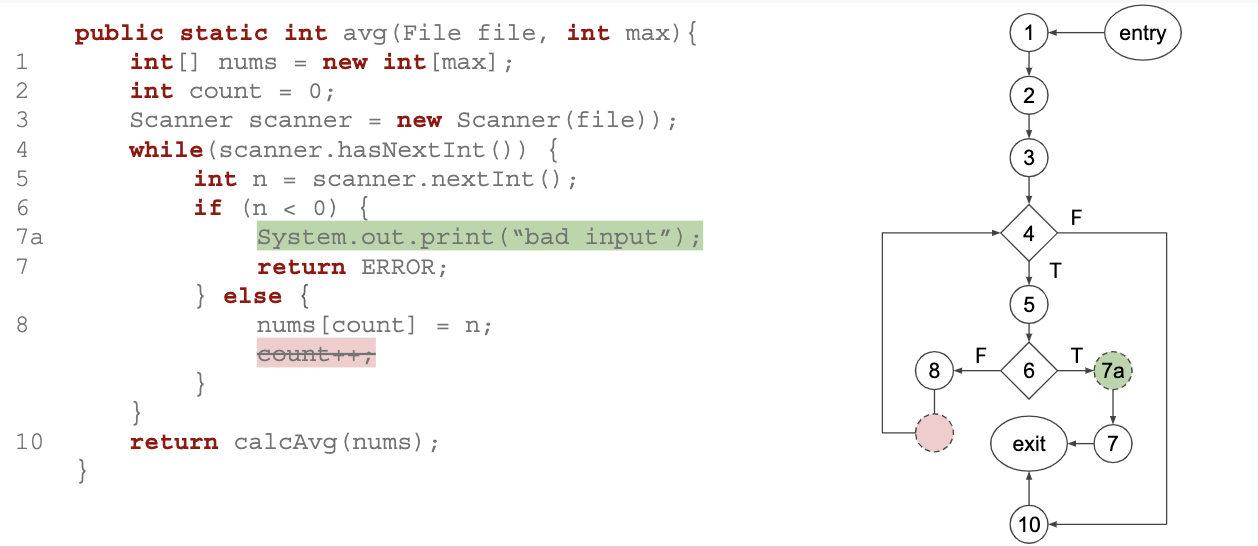
- traverse both CFGs in parallel
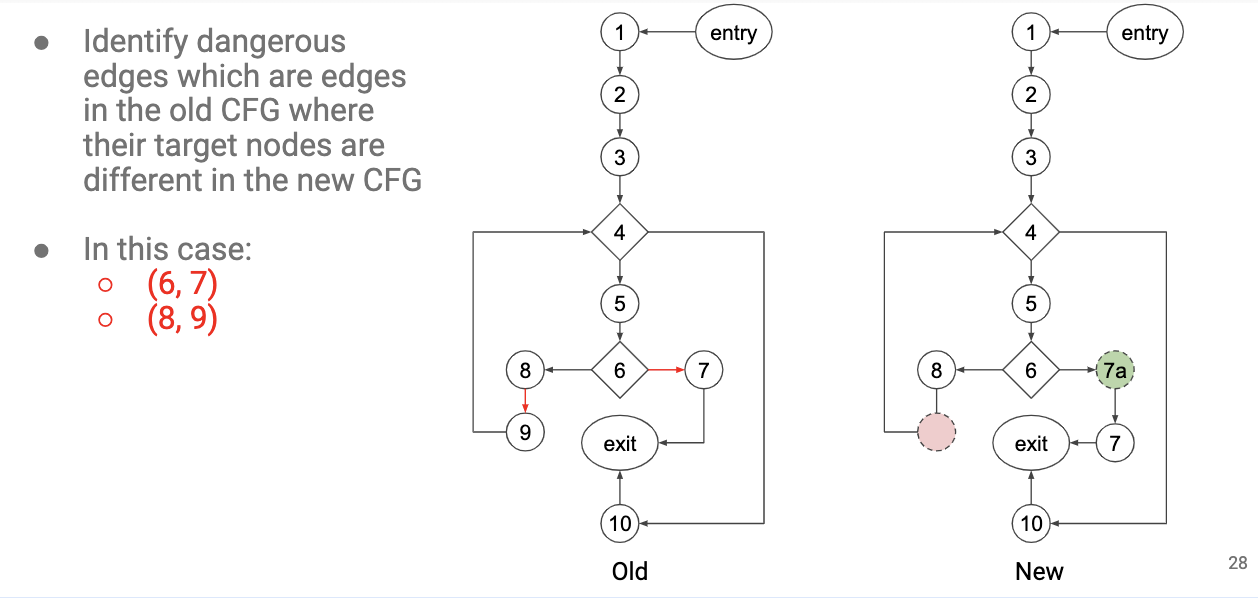
- select tests for dangerous edges
- Build CFG of original prog $P$